
Housing
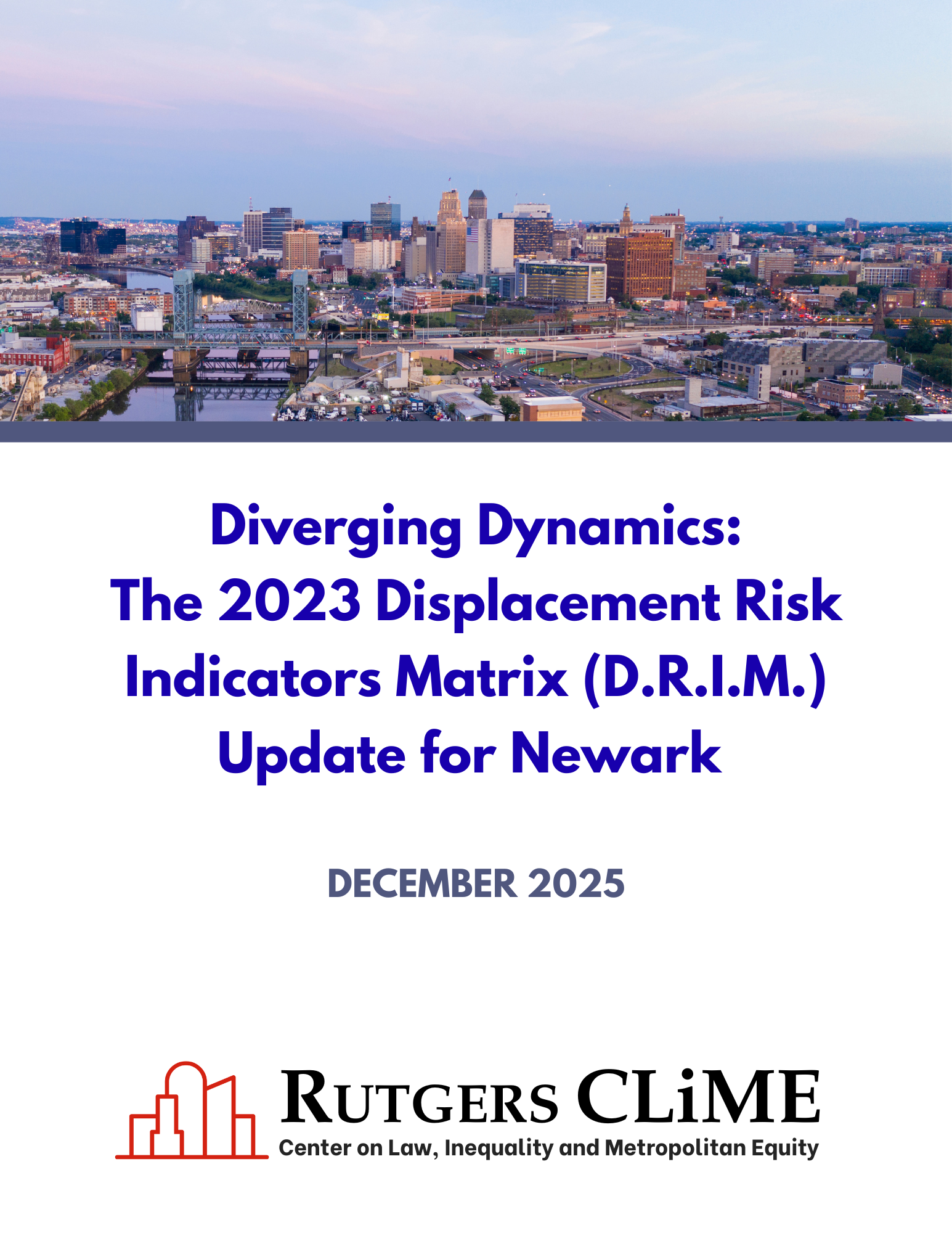
Diverging Dynamics: The 2023 Displacement Risk Indicators Matrix (D.R.I.M.) Update for Newark explores how the risk of displacement in Newark has changed since 2010. Newark is experiencing the steady erosion of affordability as rents rise faster than incomes. In this latest installment of CLiME’s displacement analysis, diverging patterns of urban change are becoming clearer across wards with uneven but unmistakable signs of gentrification.
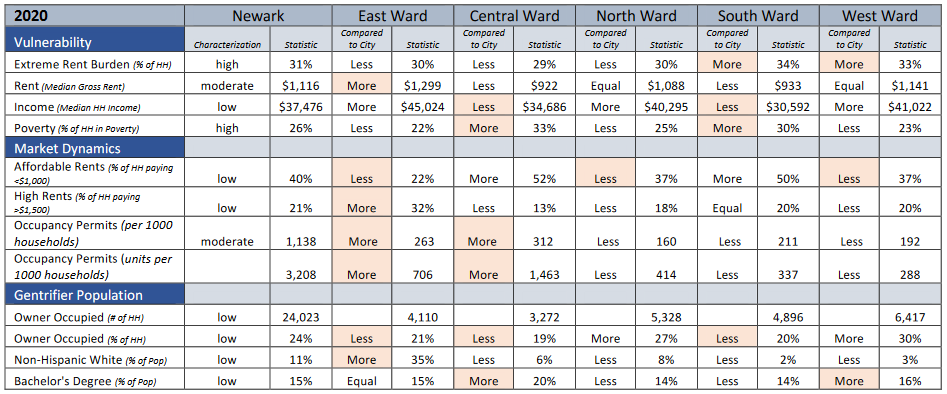
The East and Central Wards saw the most dramatic increases in new construction activity, the most rapidly rising rents, and the most pronounced increases in residents who are college-educated and/or affluent renters. The West Ward also shows signs of elevated renter vulnerability, with large increases in medium household incomes alongside rising rent burdens. The North Ward has very different housing market dynamics, with large increases in homeownership and much less residential construction. The South Ward shows the greatest signs of tenant vulnerability but also has the most affordable rental stock, compared to other parts of the city.

Metropolitan areas in New Jersey need to dramatically lower their building emissions to combat climate change and protect local health. However, metropolitan New Jersey faces several major challenges. First, federal and state law preempt New Jersey municipalities from adopting some stricter laws that could lower building emissions. Second, competition between municipalities creates a collective action problem that disincentivizes legal reform. Third, building emission reduction strategies can create unintended harm such as worsened indoor air quality and gentrification. To avoid these challenges, individual New Jersey municipalities can utilize metropolitan equity strategies to cooperate efficiently. However, the most impactful way New Jersey can decarbonize buildings may be for the state legislature to amend its building emissions benchmarking law to enable the state government to decarbonize buildings more effectively.

This report explores investor activity in Philadelphia, where corporate buyers are most active in parts of the city which are predominantly home to Black and Hispanic residents in West, North and Northeast Philadelphia. For this report, CLiME teamed up with the Reinvestment Fund and Housing Initiative at Penn, who are based in Philadelphia.
We identify the largest investors who are buying up the most single family homes, and who operate primarily as large-scale corporate landlords. The companies doing the purchasing changed during the pandemic, shifting from more local investors to those entering the market already active in other places.
We analyzed purchases of residential buildings before and during the pandemic, looking at sheriff sales, rental licensing, renovation permits, evictions, and code violations to determine the impact of these purchases on Philadelphia housing markets. We found that:
Larger corporate landlords were much more likely to evict tenants than smaller investors.
Larger investors more often took out permits to alter or improve their properties than smaller investors.
Investors large and small were much more likely to amass code violations than individual homebuyers
The largest corporate investors obtained rental licenses on 67% of the properties they acquired, compared to just 43% among smaller investors
The character of the highest-volume investors changed with the pandemic. From 2017 through 2019, eight of the top ten largest investors by volume were locally based. From 2020 through 2022, the four highest volume investors were either new to Philadelphia or had scaled up dramatically from the earlier period.
Philadelphia is a city with a proud legacy of affordable homeownership opportunities and an expanding set of tenant protections. In recent years, concerns about the impact of corporate investors purchasing single family homes in the city have grown, even as there is an evident need for capital investment in its aging housing stock. This report aims to inform policy interventions to promote stable neighborhoods, affordability, and high-quality housing options for all Philadelphians.
A few years ago, CLiME published Who Owns Newark? which showed that corporations were buying half of all 1-4 unit homes in the city. We continue to investigate and explore these issues throughout the region.

In New Jersey, new construction is exempt from price controls for 30 years, even in municipalities with rent control ordinances. Given the other exemptions available to developers, it is questionable whether this exemption is necessary to spur new construction. This memo examines that question by laying out the history of rent control in New Jersey as well as the history of the new construction exemption, looking at case law involving the exemption as well as arguments for the exemption and critique of those arguments, and proposes alternatives to the exemption as either an abolishment or revision of the exemption. The history shows how the moderate nature of rent control in New Jersey suggests that its effect on new construction is overblown, the legislative intent was more about removing barriers to new construction without considering any balance with the prevention of rent gouging, rent control is relevant towards new construction, and significant revision, if not abolishment, of the exemption would have a beneficial effect for existing affordable housing.

New Jersey's Assembly Bill A4 represents a landmark effort to comply with the Mount Laurel Doctrine and the state's growing affordable housing crisis by reforming how municipalities meet their fair share housing obligations. At the heart of this legislation is a standardized formula that requires each municipality to calculate its present and prospective affordable housing needs, along with other factors like population growth, land, and income capacity. By decentralizing housing planning, A4 shifts responsibility to local governments from the state and gives them a ten-year window to meet their fair share housing obligations.
Limited-Equity Cooperatives: A Primer on Sustainable Affordability and Wealth Building is a research report on a promising alternative to traditional homeownership in a period of scarce inventory and high interest rates. Limited equity cooperatives offer communal ownership at more affordable prices—stabilty, wealth enhancement and long-term affordability. Author Elana Simon details the purpose and structure of such housing vehicles.
Newark housing is too expensive for its residents.
CLiME’s Displacement Risk Indicators Matrix—or DRIM—originated in 2017 as a tool to measure the risk of Newark resident displacement as a result of gentrification. We found then and now that displacement risk continues to be a serious threat to housing stability in Newark as rents rise dramatically among a city of mostly renters. Yet the cause does not appear to be traditional gentrification, because the demographic profile of who lives in the city, their incomes, educations and poverty rates have not changed as dramatically as rents.
The DRIM is divided into three sets of variables set across the city as a whole, the five wards and, for the first time, neighborhoods: vulnerability, market dynamics and “gentrifier population.” Vulnerability variables ask about the economic stresses that households feel. Market dynamics variables ask about rental affordability and new construction. Gentrifier population variables ask whether the city is seeing an influx in the people whose race, housing wealth and educational attainment is associated with gentrifying populations in other cities.

This report shows that the national trend in investor buying of 1-4 unit homes in predominantly Black neighborhoods is most acute in Newark, New Jersey where almost half of all real estate sales were made by institutional buyers. The trend grew out of the foreclosure crisis that wiped out significant middle-class wealth in particular Newark neighborhoods. Those neighborhoods became the targets of investors seeking passive returns from rents. Those largely anonymous outside companies now set neighborhood housing markets on terms that primarily benefit their investors.
While CLiME detected no illegal activity, the threats to Newarkers and government policy goals are significant. They include rapidly rising rents, decreased homeownership, higher barriers to affordable housing production goals, renter displacement and less stable communities. Sadly, this reality continues a long pattern of economic threats to predominantly Black and increasingly Latino neighborhoods in a state whose communities are among the most segregated in the country. From racial exclusion to predatory lending, from foreclosure to the extraction of rents, Newark’s experience demonstrates what can happen when local economies ignore equity.
CLiME’s analysis documents a dramatic increase in institutional investor activity in Newark’s residential market starting around 2013. As of 2020, almost half of all Newark’s residential sales were to institutional buyers.

Affordable housing is increasingly scarce within the United States, and COVID-19 has dramatically exacerbated the simmering crisis in affordable housing. In New Jersey, the risk of eviction is greater than across the country, as 393,000 households are delinquent on their rent, (22.3% of households in renter-occupied housing units in New Jersey as compared with 15.8% across the country). ¹ In New Jersey, eviction pressure is faced disproportionately by residents of color, by households with children, and in urban municipalities, where more renters and more low-income households are especially vulnerable.
The New Jersey Housing Crisis in a COVID Era: Mapping Strategic Processes was a research project funded by the New Jersey State Policy Lab to explore strategic development and organizational learning in the provision of emergency rental assistance funding during the COVID-19 pandemic. This research focused on five New Jersey municipalities: Camden (Camden County), Elizabeth (Union County), Jersey City, Newark, and Trenton (Mercer County).
Housing markets rebounded after the 2007-2009 housing crisis, but homeownership rates never did. Research explains this by the rapid spread of investor buyers into housing markets following the foreclosure crisis. Large investors bought significant numbers of properties that were foreclosed on, at very low prices, frequently converting single-family (1-4 units) into rental properties. They often acquire properties in low-income and moderate-income neighborhoods. ¹
Coming out of the foreclosure crisis, these investor buyers created a new industry around large-scale single-family rental, and have been increasingly active in rental markets generally. These limited liability companies (LLCs), or “corporate landlords”, have reshaped the legal landscape of rental ownership, in part because they limit investor liability. ² Research shows they are less likely to take care of the properties, causing them to fall into disrepair or remain vacant. ³ They are also associated with higher rents and higher rates of eviction. ⁴ Meanwhile, several reports document that the largest among them (e.g.; Invitation Homes, Equity Residential) are making enormous profits even as we experience a profound housing affordability and eviction crisis. ⁵

Orange, East Orange, and Irvington are Black working-class suburban communities. While home to just under 20% of Essex’s population, they are home to almost 40% of all Black residents and only 2% of White residents. These communities are also growing fast, with surging Latino and immigrant populations from the Caribbean.
These inner-ring suburbs are challenged by elevated rates of poverty and a growing unaffordability, and they have few resources to address these pressing needs. In 2020, Orange, East Orange, and Irvington residents generated only $30,000-$40,000 in tax basis for essential public services, such as police, education and sanitation. Meanwhile, nearby Summit residents generated almost four and a half times as many resources as any of these communities, and to serve a much smaller population.

CLiME conducted an affordability and gap analysis of Newark's housing stock and found a severe gap in low-rent units. We estimate that the City needs an additional 16,234 units renting for about $750 per month to meet residents' existing needs.
CLiME’s approach to assessing affordability is rooted in the local context. We calculate a Newark Median Affordable Rent (NMAR) of $763 per month. This is $330 less than Newark’s median market rent, and more than $600 less than Fair Market Rent (FMR), created by the Department of Housing and Urban Development. We also develop a methodological innovation to integrate the City’s rental housing subsidies into the affordability analysis. This procedure, the first of its kind as far as we know, provides a much closer picture of affordability in a City where at least 28% of all units are subsidized.

In this first installment of a faculty essay series, CLiME asked Rutgers professors affiliated with the center to provide brief analysis on some of the many institutional crises exacerbated by the Coronavirus pandemic and to offer solutions. Law Professor Rachel Godsil discuses the loss of public revenues to struggling communities and offers a pipeline to millions. Political Scientist Domingo Morel reveals the growing crisis in public pension fund commitments and a possible path to meeting those obligations. Law Professor Laura Cohen takes readers inside juvenile justice to show the increased risk of viral infection incarcerated youth face as well as the steps advocates are taking on their behalf. Director David Troutt looks into the future to interrogate claims that “we are all in this together” and offers an alternative set of policy priorities we would pursue if mutuality really mattered.
Based on the previous DRIM analysis and updated 2017 DRIM analysis, three Wards have been analyzed and found to be Displacement-Risk Neighborhoods: The Central Ward, the South Ward, & the East Ward.
To better understand the trend of displacement that has occurred between years 2000, 2015, & 2017, we conduct a baseline study to analyze the specific displacement risk indicators for one Ward: The Central Ward.
With the increased use of public land for the sake of economic development, cities across the U.S. are facing an urban construction boom. Through the 1980s and 1990s, Newark’s construction boom focused on land-use policies, especially the tax abatement strategies for bringing about capital-intensive projects. Simultaneously, Newark’s shift to a more neo-liberal solution led to a decline in public housing and section 8 vouchers.
As Newark experiences unprecedented growth potential, Newarkers express more and more anxiety about the prospects of housing displacement brought on by the processes of gentrification that have transformed urban neighborhoods across the United States.
Based on the previous DRIM analysis and updated 2017 DRIM analysis, three Wards have been analyzed to be considered as Displacement-Risk Neighborhoods.
To better understand the trend of displacement that has occurred between years 2000 and 2017, we conduct a baseline study to analyze the specific displacement risk indicators.
From the perspective of many low-income families, gentrification is the ultimate social injustice; where “wealthy, usually white, newcomers are congratulated for "improving" a neighborhood whose poor, minority residents are displaced by skyrocketing rents and economic change.”
A social injustice promulgated by local government action, gentrification is no longer confined to our big cities and is increasingly impacting smaller cities and towns as municipalities seek to increase their tax base by luring wealthy residents in search of urban amenities and replace low income residents in the process.

In Tiny Houses in the City of Newark, Rutgers doctoral candidate Lenore Pearson studies innovative tiny house programs underway in Detroit, Michigan and analyzes their prospective application in Newark in a fascinating memorandum about unique urban housing solutions.

As a member of a local affordable housing coalition and partner to Mayor Baraka's effort to implement the second right-to-counsel (RTC) ordinance in the country, CLiME led the research design of such a system and the supporting basis for its legality under New Jersey law.
This memorandum was submitted to the City of Newark in early February, with recommendations for implementing a system of free legal services for indigent Newarkers (incomes below 200 percent of the median) facing imminent eviction proceedings in Essex County court.
ABSTRACT: Tax increment financing (TIF) has exploded in popularity on the municipal finance landscape as cities compete for scarce public resources to fund economic development. Previous studies evaluate TIF’s efficacy and ability to spark economic growth.
This research expands the evaluation of TIF by questioning the widespread understanding of TIF as a “self-financing” tool through an analysis of its risks and costs to taxpayers. We present a case study of the Hudson Yards redevelopment project in New York City, the country’s largest TIF-type project.

As Newark experiences unprecedented growth potential, Newarkers express more and more anxiety about the prospects of housing displacement brought on by the processes of gentrification that have transformed urban neighborhoods across the United States. Given the recent history of other cities in its metropolitan neighborhood—New York, Hoboken and Jersey City—Newark would seem poised to attract the kind of global capital that has accelerated so much economic development among …

The City of Newark is undergoing rapid transition, with creative political leadership and development cranes dotting its sky. In February 2016, CLiME launched a comprehensive study of housing trends in the City. In May 2016, CLiME led a Rutgers University-Newark anchor initiative that researching laws and policies that might promote more equitable growth in the City as it changes. This Housing Research Brief represents the first installment of our almost year-long work. It provides quantitative snapshots …
MORRISTOWN, N.J. — When the morning rush begins at Alexander Hamilton Elementary School here, students lugging oversize backpacks and fluorescent-colored lunchboxes emerge from the school buses that roll in, one after another, for 15 minutes. By the time it ends, children from some of this area’s most privileged enclaves, and from some of its poorest, file through the front doors to begin their day together.
The Morris School District was created in 1971, after a state court decision led to the merger of two Northern New Jersey communities — the mostly white suburbs of Morris Township, and the racially mixed urban hub of Morristown — into one school district for the purpose of maintaining racial and economic balance.
While it is commonly understood that the 7 million foreclosures that occurred between 2004 and 2015 fueled the Great Recession and have held back a robust recovery, the role of adverse public records is just as significant and less recognized. Nearly 35 million consumers had adverse public records between 2004 and 2015 including bankruptcies, civil judgments and federal tax liens.
Combined with the 7 million foreclosures, this means more than one in five Americans with credit records suffered an adverse event during this period. While It is also commonly understood that the Great Recession ended on June 2009, the total number of consumers having their foreclosure or negative public records still on their credit report actually peaked in 2015. This paper examines the lasting impact of these negative records on consumer spending and economic recovery.
Oakland stands at the center of a perfect storm. The city and surrounding Bay Area region are experiencing extraordinary economic growth, but housing production is not keeping pace with the escalated demands, nor is sufficient housing affordable to many existing residents and the expanding lower-income workforce. The current displacement crisis undermines the health and well being of its residents, and threatens the historic diversity that gives Oakland its strength and vitality.
The red-hot Bay Area economy is feeding a displacement crisis. Nearly 150,000 new jobs are expected to be added to the East Bay economy by 2020, but housing production is not keeping pace with escalating demands, nor is sufficient housing affordable to many existing residents and the expanding lower-income workforce. According to A Roadmap Towards Equity: Housing Solutions for Oakland, CA, the majority of current Oakland residents could not afford to rent or purchase homes at the current prices in their neighborhoods.1 This has strong implications for Oakland families who lose their housing due to eviction, foreclosure, or other events. The housing crisis imperils seniors on fixed incomes, artists, students, low-wage workers (there is no market level apartment listing affordable for a worker earning Oakland’s minimum wage of $12.55/hour), and even teachers, nurses, and first responders.
Whereas many U.S. cities have experienced a post-recession economic revival, the accompanying run-up in housing costs is threatening to undermine this success by pricing workers out of cities, lengthening commutes, and diminishing livability, the report notes. As a result, local officials are turning to inclusionary zoning (IZ) as a way to combat the shortage of housing that is affordable to moderate- and lower-income workers.
IZ policies take a market-based approach to affordable housing development by requiring or incentivizing the creation of below-market-rate units in exchange for approval of a market-rate project. Inclusionary zoning leverages private development to achieve a public benefit.
ABSTRACT: Housing policy can play an important role in improving or impeding the economic well-being of low-income households. Through this paper, we aim to better equip researchers, policymakers, and practitioners for conversations about the links between housing policy and economic mobility. The first half of this paper clarifies common definitions and measurements of inequality and mobility. Adopting the lens of economic mobility for examining how housing policies can address challenges of inequality in society today, the second half of the paper looks at five categories of housing policy levers that affect economic mobility: tax policy, block grants, rental assistance, fair housing, and homeownership programs.
Over the past year, scenes of civil unrest have played out in the deteriorating inner-ring suburb of Ferguson and the traditional urban ghetto of inner-city Baltimore. The proximate cause of these conflicts has been brutal interactions between police and unarmed black men, leading to protests that include violent confrontations with police, but no single incident can explain the full extent of the protesters’ rage and frustration. The riots and protests—which have occurred in racially-segregated, high-poverty neighborhoods, bringing back images of the “long, hot summers” of the 1960s—have sparked a national conversation about race, violence, and policing that is long overdue.
ABSTRACT: The Moving to Opportunity (MTO) experiment offered randomly selected families living in high poverty housing projects housing vouchers to move to lower-poverty neighborhoods. We present new evidence on the impacts of MTO on children’s long-term outcomes using administrative data from tax returns.
We find that moving to a lower-poverty neighborhood significantly improves college attendance rates and earnings for children who were young (below age 13) when their families moved. These children also live in better neighborhoods themselves as adults and are less likely to become single parents.
Homeownership is one of the most esteemed values in American society. As such, homeownership is heavily promoted and subsidized by both federal and local governments in the form of tax credits, tax deductions, federally subsidized loans, and federal mortgage insurance from the Federal Housing Authority. The rationale for these subsidies is that homeowners make better citizens, which has been substantiated by researchers using measures such as local voting and church attendance.
Housing policies are at the root of structural inequalities. Local and state policies bear directly on housing markets, which in turn affect the distribution and quality of goods and services. Our housing analyses examine measures of affordability, displacement risk and the burdens on both owners and renters. Our recommendations focus on how institutions can promote housing equity and reduce the destabilizing effects of housing insecurity on health, education, employment, public safety and broader indicators of economic inequality.
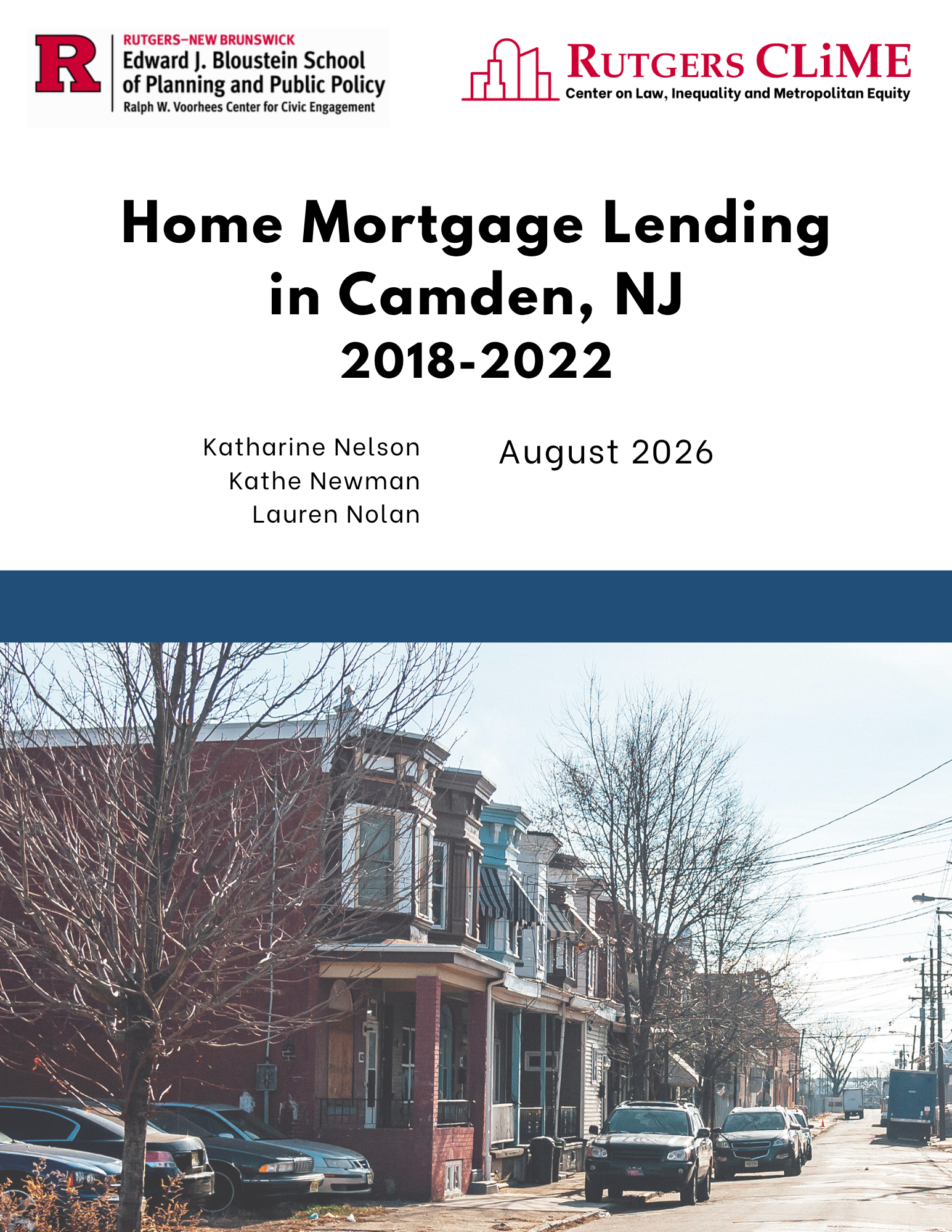
In partnership with the Rutgers Bloustein School's Voorhees Center for Civic Engagement and St. Joseph's Carpenter Society, a community development corporation in Camden, New Jersey, we sought to better understand home purchase and improvement lending in Camden between 2018 and 2022, a decade after the 2008 financial and liquidity crisis and the 2009 Great Recession significantly restricted credit access. We looked at patterns of home purchase and improvement mortgage originations, applications, and denials in Camden and found higher mortgage denial rates than elsewhere in the region, more expensive mortgages from the companies that have lower denial rates, and a critical gap in access to home repair loans. Our findings point to the prominent importance of non-depository mortgage companies in the provision of housing credit, raising concerns both about lender regulation and the need for greater bank presence in Camden's mortgage markets.

Why is The “Rent So Damned High”? explores the drivers of high and rising rents and proposes a series of policies to address rental unaffordability in New Jersey and respond to changes at the federal level. Most experts say the chief explanation for high rents is an undersupply of housing and push a “build, build, build” strategy to bring rents down. Our findings challenge the consensus. Through a deep dive of academic and public research, we identified four primary drivers of high and rising rents: inflation, undersupply, widening inequality, and the consolidation and professionalization of landlords and real estate.
Federal policy is embracing building as the foremost solution to the affordability crisis. Trump’s Big Bill permanently expanded the country’s largest affordable housing production subsidy program, the Low-Income Housing Tax Credit (LIHTC). Meanwhile, deeper subsidy programs that can reach low-income renters are threatened with large cuts. To make housing affordable, we must also address stagnant incomes and the consolidation of homebuilders and landlords.

New Jersey homeowners are sinking in monthly bills. In this brief, we explore the sky-high and rapidly rising costs of being a homeowner in New Jersey. This includes both mortgage and non-mortgage housing costs. New Jersey has the property taxes, and among the most expensive housing prices in the country. In addition, New Jersey homeowners pay 20 percent more in utility costs than the national average, and are now facing soaring electricity bills related to supply challenges and the new demands of AI data centers. New Jersey’s homeowners’ insurance premiums are also going up much faster than other states, related to private companies’ responses to more extreme weather and construction and labor costs. As these various costs add up, more homeowners – especially those with lower incomes – are sinking into debt and many are deferring home repairs and maintenance.
Limited-Equity Cooperatives: A Primer on Sustainable Affordability and Wealth Building is a research report on a promising alternative to traditional homeownership in a period of scarce inventory and high interest rates. Limited equity cooperatives offer communal ownership at more affordable prices—stabilty, wealth enhancement and long-term affordability. Author Elana Simon details the purpose and structure of such housing vehicles.
Affordable housing is increasingly scarce within the United States, and COVID-19 has dramatically exacerbated the simmering crisis in affordable housing. In New Jersey, the risk of eviction is greater than across the country, as 393,000 households are delinquent on their rent, (22.3% of households in renter-occupied housing units in New Jersey as compared with 15.8% across the country). ¹ In New Jersey, eviction pressure is faced disproportionately by residents of color, by households with children, and in urban municipalities, where more renters and more low-income households are especially vulnerable.
The New Jersey Housing Crisis in a COVID Era: Mapping Strategic Processes was a research project funded by the New Jersey State Policy Lab to explore strategic development and organizational learning in the provision of emergency rental assistance funding during the COVID-19 pandemic. This research focused on five New Jersey municipalities: Camden (Camden County), Elizabeth (Union County), Jersey City, Newark, and Trenton (Mercer County).
Orange, East Orange, and Irvington are Black working-class suburban communities. While home to just under 20% of Essex’s population, they are home to almost 40% of all Black residents and only 2% of White residents. These communities are also growing fast, with surging Latino and immigrant populations from the Caribbean.
These inner-ring suburbs are challenged by elevated rates of poverty and a growing unaffordability, and they have few resources to address these pressing needs. In 2020, Orange, East Orange, and Irvington residents generated only $30,000-$40,000 in tax basis for essential public services, such as police, education and sanitation. Meanwhile, nearby Summit residents generated almost four and a half times as many resources as any of these communities, and to serve a much smaller population.
CLiME conducted an affordability and gap analysis of Newark's housing stock and found a severe gap in low-rent units. We estimate that the City needs an additional 16,234 units renting for about $750 per month to meet residents' existing needs.
CLiME’s approach to assessing affordability is rooted in the local context. We calculate a Newark Median Affordable Rent (NMAR) of $763 per month. This is $330 less than Newark’s median market rent, and more than $600 less than Fair Market Rent (FMR), created by the Department of Housing and Urban Development. We also develop a methodological innovation to integrate the City’s rental housing subsidies into the affordability analysis. This procedure, the first of its kind as far as we know, provides a much closer picture of affordability in a City where at least 28% of all units are subsidized.
As a member of a local affordable housing coalition and partner to Mayor Baraka's effort to implement the second right-to-counsel (RTC) ordinance in the country, CLiME led the research design of such a system and the supporting basis for its legality under New Jersey law.
This memorandum was submitted to the City of Newark in early February, with recommendations for implementing a system of free legal services for indigent Newarkers (incomes below 200 percent of the median) facing imminent eviction proceedings in Essex County court.
Oakland stands at the center of a perfect storm. The city and surrounding Bay Area region are experiencing extraordinary economic growth, but housing production is not keeping pace with the escalated demands, nor is sufficient housing affordable to many existing residents and the expanding lower-income workforce. The current displacement crisis undermines the health and well being of its residents, and threatens the historic diversity that gives Oakland its strength and vitality.
The red-hot Bay Area economy is feeding a displacement crisis. Nearly 150,000 new jobs are expected to be added to the East Bay economy by 2020, but housing production is not keeping pace with escalating demands, nor is sufficient housing affordable to many existing residents and the expanding lower-income workforce. According to A Roadmap Towards Equity: Housing Solutions for Oakland, CA, the majority of current Oakland residents could not afford to rent or purchase homes at the current prices in their neighborhoods.1 This has strong implications for Oakland families who lose their housing due to eviction, foreclosure, or other events. The housing crisis imperils seniors on fixed incomes, artists, students, low-wage workers (there is no market level apartment listing affordable for a worker earning Oakland’s minimum wage of $12.55/hour), and even teachers, nurses, and first responders.
Affordability
Gentrification
Diverging Dynamics: The 2023 Displacement Risk Indicators Matrix (D.R.I.M.) Update for Newark explores how the risk of displacement in Newark has changed since 2010. Newark is experiencing the steady erosion of affordability as rents rise faster than incomes. In this latest installment of CLiME’s displacement analysis, diverging patterns of urban change are becoming clearer across wards with uneven but unmistakable signs of gentrification.
The East and Central Wards saw the most dramatic increases in new construction activity, the most rapidly rising rents, and the most pronounced increases in residents who are college-educated and/or affluent renters. The West Ward also shows signs of elevated renter vulnerability, with large increases in medium household incomes alongside rising rent burdens. The North Ward has very different housing market dynamics, with large increases in homeownership and much less residential construction. The South Ward shows the greatest signs of tenant vulnerability but also has the most affordable rental stock, compared to other parts of the city.
Newark housing is too expensive for its residents.
CLiME’s Displacement Risk Indicators Matrix—or DRIM—originated in 2017 as a tool to measure the risk of Newark resident displacement as a result of gentrification. We found then and now that displacement risk continues to be a serious threat to housing stability in Newark as rents rise dramatically among a city of mostly renters. Yet the cause does not appear to be traditional gentrification, because the demographic profile of who lives in the city, their incomes, educations and poverty rates have not changed as dramatically as rents.
The DRIM is divided into three sets of variables set across the city as a whole, the five wards and, for the first time, neighborhoods: vulnerability, market dynamics and “gentrifier population.” Vulnerability variables ask about the economic stresses that households feel. Market dynamics variables ask about rental affordability and new construction. Gentrifier population variables ask whether the city is seeing an influx in the people whose race, housing wealth and educational attainment is associated with gentrifying populations in other cities.
Based on the previous DRIM analysis and updated 2017 DRIM analysis, three Wards have been analyzed and found to be Displacement-Risk Neighborhoods: The Central Ward, the South Ward, & the East Ward.
To better understand the trend of displacement that has occurred between years 2000, 2015, & 2017, we conduct a baseline study to analyze the specific displacement risk indicators for one Ward: The Central Ward.
With the increased use of public land for the sake of economic development, cities across the U.S. are facing an urban construction boom. Through the 1980s and 1990s, Newark’s construction boom focused on land-use policies, especially the tax abatement strategies for bringing about capital-intensive projects. Simultaneously, Newark’s shift to a more neo-liberal solution led to a decline in public housing and section 8 vouchers.
As Newark experiences unprecedented growth potential, Newarkers express more and more anxiety about the prospects of housing displacement brought on by the processes of gentrification that have transformed urban neighborhoods across the United States.
Based on the previous DRIM analysis and updated 2017 DRIM analysis, three Wards have been analyzed to be considered as Displacement-Risk Neighborhoods.
To better understand the trend of displacement that has occurred between years 2000 and 2017, we conduct a baseline study to analyze the specific displacement risk indicators.
From the perspective of many low-income families, gentrification is the ultimate social injustice; where “wealthy, usually white, newcomers are congratulated for "improving" a neighborhood whose poor, minority residents are displaced by skyrocketing rents and economic change.”
A social injustice promulgated by local government action, gentrification is no longer confined to our big cities and is increasingly impacting smaller cities and towns as municipalities seek to increase their tax base by luring wealthy residents in search of urban amenities and replace low income residents in the process.
As Newark experiences unprecedented growth potential, Newarkers express more and more anxiety about the prospects of housing displacement brought on by the processes of gentrification that have transformed urban neighborhoods across the United States. Given the recent history of other cities in its metropolitan neighborhood—New York, Hoboken and Jersey City—Newark would seem poised to attract the kind of global capital that has accelerated so much economic development among …
Policy
The City of Newark is undergoing rapid transition, with creative political leadership and development cranes dotting its sky. In February 2016, CLiME launched a comprehensive study of housing trends in the City. In May 2016, CLiME led a Rutgers University-Newark anchor initiative that researching laws and policies that might promote more equitable growth in the City as it changes. This Housing Research Brief represents the first installment of our almost year-long work. It provides quantitative snapshots …
MORRISTOWN, N.J. — When the morning rush begins at Alexander Hamilton Elementary School here, students lugging oversize backpacks and fluorescent-colored lunchboxes emerge from the school buses that roll in, one after another, for 15 minutes. By the time it ends, children from some of this area’s most privileged enclaves, and from some of its poorest, file through the front doors to begin their day together.
The Morris School District was created in 1971, after a state court decision led to the merger of two Northern New Jersey communities — the mostly white suburbs of Morris Township, and the racially mixed urban hub of Morristown — into one school district for the purpose of maintaining racial and economic balance.
While it is commonly understood that the 7 million foreclosures that occurred between 2004 and 2015 fueled the Great Recession and have held back a robust recovery, the role of adverse public records is just as significant and less recognized. Nearly 35 million consumers had adverse public records between 2004 and 2015 including bankruptcies, civil judgments and federal tax liens.
Combined with the 7 million foreclosures, this means more than one in five Americans with credit records suffered an adverse event during this period. While It is also commonly understood that the Great Recession ended on June 2009, the total number of consumers having their foreclosure or negative public records still on their credit report actually peaked in 2015. This paper examines the lasting impact of these negative records on consumer spending and economic recovery.
ABSTRACT: Housing policy can play an important role in improving or impeding the economic well-being of low-income households. Through this paper, we aim to better equip researchers, policymakers, and practitioners for conversations about the links between housing policy and economic mobility. The first half of this paper clarifies common definitions and measurements of inequality and mobility. Adopting the lens of economic mobility for examining how housing policies can address challenges of inequality in society today, the second half of the paper looks at five categories of housing policy levers that affect economic mobility: tax policy, block grants, rental assistance, fair housing, and homeownership programs.
Over the past year, scenes of civil unrest have played out in the deteriorating inner-ring suburb of Ferguson and the traditional urban ghetto of inner-city Baltimore. The proximate cause of these conflicts has been brutal interactions between police and unarmed black men, leading to protests that include violent confrontations with police, but no single incident can explain the full extent of the protesters’ rage and frustration. The riots and protests—which have occurred in racially-segregated, high-poverty neighborhoods, bringing back images of the “long, hot summers” of the 1960s—have sparked a national conversation about race, violence, and policing that is long overdue.
SUMMARY: Through this final rule, HUD provides HUD program participants with an approach to more effectively and efficiently incorporate into their planning processes the duty to affirmatively further the purposes and policies of the Fair Housing Act, which is title VIII of the Civil Rights Act of 1968. The Fair Housing Act not only prohibits discrimination but, in conjunction with other statutes, directs HUD’s program participants to take significant actions to overcome historic patterns of segregation, achieve truly balanced and integrated living patterns, promote fair housing choice, and foster inclusive communities that are free from discrimination. The approach to affirmatively furthering fair housing carried out by HUD program participants prior to this rule, which involved an analysis of impediments to fair housing choice and a certification that the program participant will affirmatively further fair housing, has not been as effective as originally envisioned. This rule refines the prior approach by replacing the analysis of impediments with a fair housing assessment that should better inform program participants’ planning processes with a view toward better aiding HUD program participants to fulfill this statutory obligation.
Homeownership is one of the most esteemed values in American society. As such, homeownership is heavily promoted and subsidized by both federal and local governments in the form of tax credits, tax deductions, federally subsidized loans, and federal mortgage insurance from the Federal Housing Authority. The rationale for these subsidies is that homeowners make better citizens, which has been substantiated by researchers using measures such as local voting and church attendance.
FROM THE EXECUTIVE SUMMARY: Equity and access to opportunity are critical underpinnings of TOGETHER North Jersey’s Regional Plan for Sustainable Development. Therefore, the planning process includes the preparation of this assessment of Fair Housing and Equity in the Northern New Jersey region.
As part of the process to develop a Regional Plan for Sustainable Development (RPSD) for the TOGETHER North Jersey planning region, the TNJ Project Team worked with the TOGETHER North Jersey Steering Committee and Standing Committees to conduct a Fair Housing and Equity Assessment (FHEA) for the region, resulting in this report.

Presented November 7, 2014 as part of the Equity and Opportunity Studies Fellowship workshop series, a partnership between CLiME at the Rutgers Law School, and the Graduate School at Rutgers University-Newark

In order to understand affordable housing and the issues surrounding public housing, we must know the background of how it evolved. The following section will provide landmark history of affordable housing and its development in the United States. This section will also discuss the evolution of affordable housing and the impact it has had on American families.
Since 1975, the Mount Laurel doctrine has required that New Jersey municipalities provide their fair share of the regional need for low and moderate-income housing. Yet despite this landmark decision, New Jersey is still one of the top ten most racially and economically segregated states. In this paper, I will provide a working definition of exclusionary zoning in the both the economic and racial contexts. I will argue that despite the powerful efforts of the judiciary to position New Jersey’s at the forefront of inclusionary land use policy, the practice of exclusionary zoning …
In response to requests from State, State-funded, and Entitlement jurisdictions, the Department of Housing and Urban Development (HUD) has developed this Fair Housing Planning Guide. Many of you requested information on fulfilling the fair housing requirements of the Consolidated Plan and Community Development Block Grant (CDBG) Regulations. (The Consolidated Plan Regulation uses the term “affirmatively furthering fair housing” and the CDBG Regulation uses the term “fair housing planning.” This Guide uses “fair housing planning” to refer to the affirmative obligations of both regulations.)
This Guide is written to provide you with information on how to conduct an Analysis of Impediments to Fair Housing Choice (AI), undertake activities to correct the identified impediments, and the types of documentary records to be maintained. This Guide should be used by State, State-funded, and Entitlement jurisdictions along with applicable HUD regulations pertaining to fair housing.
ABSTRACT: Combining statistical and ethnographic analyses, this article explores the prevalence and ramifications of eviction in the lives of the urban poor. A quantitative analysis of administrative and survey data finds that eviction is commonplace in inner-city black neighborhoods and that women from those neighborhoods are evicted at significantly higher rates than men. A qualitative analysis of ethnographic data based on fieldwork among evicted tenants and their landlords reveals multiple mechanisms propelling this discrepancy. In poor black neighborhoods, eviction is to women what incarceration is to men: a typical but severely consequential occurrence contributing to the reproduction of urban poverty.
The New Jersey Supreme Court‘s Mount Laurel decisions (1975 and 1983) ruled that local zoning had to take into account regional housing needs, obligating the state‘s 566 localities to provide their ―fair share of affordable housing. Although these two decisions havelong been seen across the nation as seminal ones with respect to land use and affordable housing opportunity, their role in New Jersey land use regulation and practice remains hotly contested many decades later. The cumbersome procedures and micro-management of local planning that have …
The community land trust (CLT) movement is young but expanding rapidly. Nearly 20 community land trusts are started every year as either new nonprofits or as programs or subsidiaries of existing organizations. Fueling this proliferation is a dramatic increase in local government investment and involvement. Over the past decade, a growing number of cities and counties have chosen not only to support existing CLTs, but also to start new ones, actively guiding urban development and sponsoring affordable housing initiatives.
Two key policy needs are driving increased city and county interest in CLTs, particularly in jurisdictions that put a social priority on promoting homeownership for lower-income families and a fiscal priority on protecting the public’s investment in affordable housing.
Corporate Investors
This report explores investor activity in Philadelphia, where corporate buyers are most active in parts of the city which are predominantly home to Black and Hispanic residents in West, North and Northeast Philadelphia. For this report, CLiME teamed up with the Reinvestment Fund and Housing Initiative at Penn, who are based in Philadelphia.
We identify the largest investors who are buying up the most single family homes, and who operate primarily as large-scale corporate landlords. The companies doing the purchasing changed during the pandemic, shifting from more local investors to those entering the market already active in other places.
We analyzed purchases of residential buildings before and during the pandemic, looking at sheriff sales, rental licensing, renovation permits, evictions, and code violations to determine the impact of these purchases on Philadelphia housing markets. We found that:
Larger corporate landlords were much more likely to evict tenants than smaller investors.
Larger investors more often took out permits to alter or improve their properties than smaller investors.
Investors large and small were much more likely to amass code violations than individual homebuyers
The largest corporate investors obtained rental licenses on 67% of the properties they acquired, compared to just 43% among smaller investors
The character of the highest-volume investors changed with the pandemic. From 2017 through 2019, eight of the top ten largest investors by volume were locally based. From 2020 through 2022, the four highest volume investors were either new to Philadelphia or had scaled up dramatically from the earlier period.
Philadelphia is a city with a proud legacy of affordable homeownership opportunities and an expanding set of tenant protections. In recent years, concerns about the impact of corporate investors purchasing single family homes in the city have grown, even as there is an evident need for capital investment in its aging housing stock. This report aims to inform policy interventions to promote stable neighborhoods, affordability, and high-quality housing options for all Philadelphians.
A few years ago, CLiME published Who Owns Newark? which showed that corporations were buying half of all 1-4 unit homes in the city. We continue to investigate and explore these issues throughout the region.
This report shows that the national trend in investor buying of 1-4 unit homes in predominantly Black neighborhoods is most acute in Newark, New Jersey where almost half of all real estate sales were made by institutional buyers. The trend grew out of the foreclosure crisis that wiped out significant middle-class wealth in particular Newark neighborhoods. Those neighborhoods became the targets of investors seeking passive returns from rents. Those largely anonymous outside companies now set neighborhood housing markets on terms that primarily benefit their investors.
While CLiME detected no illegal activity, the threats to Newarkers and government policy goals are significant. They include rapidly rising rents, decreased homeownership, higher barriers to affordable housing production goals, renter displacement and less stable communities. Sadly, this reality continues a long pattern of economic threats to predominantly Black and increasingly Latino neighborhoods in a state whose communities are among the most segregated in the country. From racial exclusion to predatory lending, from foreclosure to the extraction of rents, Newark’s experience demonstrates what can happen when local economies ignore equity.
CLiME’s analysis documents a dramatic increase in institutional investor activity in Newark’s residential market starting around 2013. As of 2020, almost half of all Newark’s residential sales were to institutional buyers.
Housing markets rebounded after the 2007-2009 housing crisis, but homeownership rates never did. Research explains this by the rapid spread of investor buyers into housing markets following the foreclosure crisis. Large investors bought significant numbers of properties that were foreclosed on, at very low prices, frequently converting single-family (1-4 units) into rental properties. They often acquire properties in low-income and moderate-income neighborhoods. ¹
Coming out of the foreclosure crisis, these investor buyers created a new industry around large-scale single-family rental, and have been increasingly active in rental markets generally. These limited liability companies (LLCs), or “corporate landlords”, have reshaped the legal landscape of rental ownership, in part because they limit investor liability. ² Research shows they are less likely to take care of the properties, causing them to fall into disrepair or remain vacant. ³ They are also associated with higher rents and higher rates of eviction. ⁴ Meanwhile, several reports document that the largest among them (e.g.; Invitation Homes, Equity Residential) are making enormous profits even as we experience a profound housing affordability and eviction crisis. ⁵
The City of Newark is undergoing rapid transition, with creative political leadership and development cranes dotting its sky. In February 2016, CLiME launched a comprehensive study of housing trends in the City. In May 2016, CLiME led a Rutgers University-Newark anchor initiative that researching laws and policies that might promote more equitable growth in the City as it changes. This Housing Research Brief represents the first installment of our almost year-long work. It provides quantitative snapshots …
MORRISTOWN, N.J. — When the morning rush begins at Alexander Hamilton Elementary School here, students lugging oversize backpacks and fluorescent-colored lunchboxes emerge from the school buses that roll in, one after another, for 15 minutes. By the time it ends, children from some of this area’s most privileged enclaves, and from some of its poorest, file through the front doors to begin their day together.
The Morris School District was created in 1971, after a state court decision led to the merger of two Northern New Jersey communities — the mostly white suburbs of Morris Township, and the racially mixed urban hub of Morristown — into one school district for the purpose of maintaining racial and economic balance.
While it is commonly understood that the 7 million foreclosures that occurred between 2004 and 2015 fueled the Great Recession and have held back a robust recovery, the role of adverse public records is just as significant and less recognized. Nearly 35 million consumers had adverse public records between 2004 and 2015 including bankruptcies, civil judgments and federal tax liens.
Combined with the 7 million foreclosures, this means more than one in five Americans with credit records suffered an adverse event during this period. While It is also commonly understood that the Great Recession ended on June 2009, the total number of consumers having their foreclosure or negative public records still on their credit report actually peaked in 2015. This paper examines the lasting impact of these negative records on consumer spending and economic recovery.
ABSTRACT: Housing policy can play an important role in improving or impeding the economic well-being of low-income households. Through this paper, we aim to better equip researchers, policymakers, and practitioners for conversations about the links between housing policy and economic mobility. The first half of this paper clarifies common definitions and measurements of inequality and mobility. Adopting the lens of economic mobility for examining how housing policies can address challenges of inequality in society today, the second half of the paper looks at five categories of housing policy levers that affect economic mobility: tax policy, block grants, rental assistance, fair housing, and homeownership programs.
Over the past year, scenes of civil unrest have played out in the deteriorating inner-ring suburb of Ferguson and the traditional urban ghetto of inner-city Baltimore. The proximate cause of these conflicts has been brutal interactions between police and unarmed black men, leading to protests that include violent confrontations with police, but no single incident can explain the full extent of the protesters’ rage and frustration. The riots and protests—which have occurred in racially-segregated, high-poverty neighborhoods, bringing back images of the “long, hot summers” of the 1960s—have sparked a national conversation about race, violence, and policing that is long overdue.
SUMMARY: Through this final rule, HUD provides HUD program participants with an approach to more effectively and efficiently incorporate into their planning processes the duty to affirmatively further the purposes and policies of the Fair Housing Act, which is title VIII of the Civil Rights Act of 1968. The Fair Housing Act not only prohibits discrimination but, in conjunction with other statutes, directs HUD’s program participants to take significant actions to overcome historic patterns of segregation, achieve truly balanced and integrated living patterns, promote fair housing choice, and foster inclusive communities that are free from discrimination. The approach to affirmatively furthering fair housing carried out by HUD program participants prior to this rule, which involved an analysis of impediments to fair housing choice and a certification that the program participant will affirmatively further fair housing, has not been as effective as originally envisioned. This rule refines the prior approach by replacing the analysis of impediments with a fair housing assessment that should better inform program participants’ planning processes with a view toward better aiding HUD program participants to fulfill this statutory obligation.
Homeownership is one of the most esteemed values in American society. As such, homeownership is heavily promoted and subsidized by both federal and local governments in the form of tax credits, tax deductions, federally subsidized loans, and federal mortgage insurance from the Federal Housing Authority. The rationale for these subsidies is that homeowners make better citizens, which has been substantiated by researchers using measures such as local voting and church attendance.
FROM THE EXECUTIVE SUMMARY: Equity and access to opportunity are critical underpinnings of TOGETHER North Jersey’s Regional Plan for Sustainable Development. Therefore, the planning process includes the preparation of this assessment of Fair Housing and Equity in the Northern New Jersey region.
As part of the process to develop a Regional Plan for Sustainable Development (RPSD) for the TOGETHER North Jersey planning region, the TNJ Project Team worked with the TOGETHER North Jersey Steering Committee and Standing Committees to conduct a Fair Housing and Equity Assessment (FHEA) for the region, resulting in this report.
Presented November 7, 2014 as part of the Equity and Opportunity Studies Fellowship workshop series, a partnership between CLiME at the Rutgers Law School, and the Graduate School at Rutgers University-Newark
In order to understand affordable housing and the issues surrounding public housing, we must know the background of how it evolved. The following section will provide landmark history of affordable housing and its development in the United States. This section will also discuss the evolution of affordable housing and the impact it has had on American families.
Since 1975, the Mount Laurel doctrine has required that New Jersey municipalities provide their fair share of the regional need for low and moderate-income housing. Yet despite this landmark decision, New Jersey is still one of the top ten most racially and economically segregated states. In this paper, I will provide a working definition of exclusionary zoning in the both the economic and racial contexts. I will argue that despite the powerful efforts of the judiciary to position New Jersey’s at the forefront of inclusionary land use policy, the practice of exclusionary zoning …
In response to requests from State, State-funded, and Entitlement jurisdictions, the Department of Housing and Urban Development (HUD) has developed this Fair Housing Planning Guide. Many of you requested information on fulfilling the fair housing requirements of the Consolidated Plan and Community Development Block Grant (CDBG) Regulations. (The Consolidated Plan Regulation uses the term “affirmatively furthering fair housing” and the CDBG Regulation uses the term “fair housing planning.” This Guide uses “fair housing planning” to refer to the affirmative obligations of both regulations.)
This Guide is written to provide you with information on how to conduct an Analysis of Impediments to Fair Housing Choice (AI), undertake activities to correct the identified impediments, and the types of documentary records to be maintained. This Guide should be used by State, State-funded, and Entitlement jurisdictions along with applicable HUD regulations pertaining to fair housing.
ABSTRACT: Combining statistical and ethnographic analyses, this article explores the prevalence and ramifications of eviction in the lives of the urban poor. A quantitative analysis of administrative and survey data finds that eviction is commonplace in inner-city black neighborhoods and that women from those neighborhoods are evicted at significantly higher rates than men. A qualitative analysis of ethnographic data based on fieldwork among evicted tenants and their landlords reveals multiple mechanisms propelling this discrepancy. In poor black neighborhoods, eviction is to women what incarceration is to men: a typical but severely consequential occurrence contributing to the reproduction of urban poverty.
The New Jersey Supreme Court‘s Mount Laurel decisions (1975 and 1983) ruled that local zoning had to take into account regional housing needs, obligating the state‘s 566 localities to provide their ―fair share of affordable housing. Although these two decisions havelong been seen across the nation as seminal ones with respect to land use and affordable housing opportunity, their role in New Jersey land use regulation and practice remains hotly contested many decades later. The cumbersome procedures and micro-management of local planning that have …
The community land trust (CLT) movement is young but expanding rapidly. Nearly 20 community land trusts are started every year as either new nonprofits or as programs or subsidiaries of existing organizations. Fueling this proliferation is a dramatic increase in local government investment and involvement. Over the past decade, a growing number of cities and counties have chosen not only to support existing CLTs, but also to start new ones, actively guiding urban development and sponsoring affordable housing initiatives.
Two key policy needs are driving increased city and county interest in CLTs, particularly in jurisdictions that put a social priority on promoting homeownership for lower-income families and a fiscal priority on protecting the public’s investment in affordable housing.