
Civil Rights Initiative
This is a report on the material consequences of federal “anti-DEI” policies on Black people in the U.S. It examines how the Trump Administration’s recharacterization of diversity, equity, and inclusion (DEI) as “illegal,” “wasteful,” and “immoral” has driven widespread dismantling of DEI initiatives across education and employment, producing disproportionate harms for Black individuals and communities. Although framed as efforts to enforce civil rights law and promote neutrality, these policies operate through funding threats, legal ambiguity, and administrative pressure to curtail programs designed to address longstanding racial inequality. By tracing the material consequences of these policies, the report demonstrates how the dismantling of DEI infrastructure has already constrained access to education, weakened employment pipelines and eroded critical community protections.
This Update documents the Trump Administration's continued efforts to rewrite the meaning of racial equality in the United States. The administration’s efforts have kept pace with their first ten months, collected for CLiME’s November 2025 report presented as a four-pronged strategy aimed at:
Redefining race discrimination through a theory of antidiscrimination doctrine developed by the overwhelmingly white conservative legal movement, which has resisted racial progress through the courts since the at least the 1970s;
Dismantling the federal institutions responsible for civil rights enforcement by eliminating people and offices committed to the work of restorative justice and racial equity and repopulating those spaces with a sparse few ideological loyalists who selectively enforce civil rights laws through this redefined, ahistorical understanding of antidiscrimination;
Enforcing this colorblind, reverse-race discrimination ideology by weaponizing the federal checkbook to coerce institutions into ideological compliance and to defund any program or research that may document ongoing, system racial inequalities or support Black, Latino and Indigenous communities in any way; and
White washing racial gerrymandering efforts through political gerrymandering, while the Court ends the Voting Rights Act as we know it by subverting claims of racial discrimination to achieve policy goals–the effects of which often involve civil rights retrenchment–all the while knowing that the Supreme Court is ideologically and doctrinally aligned.
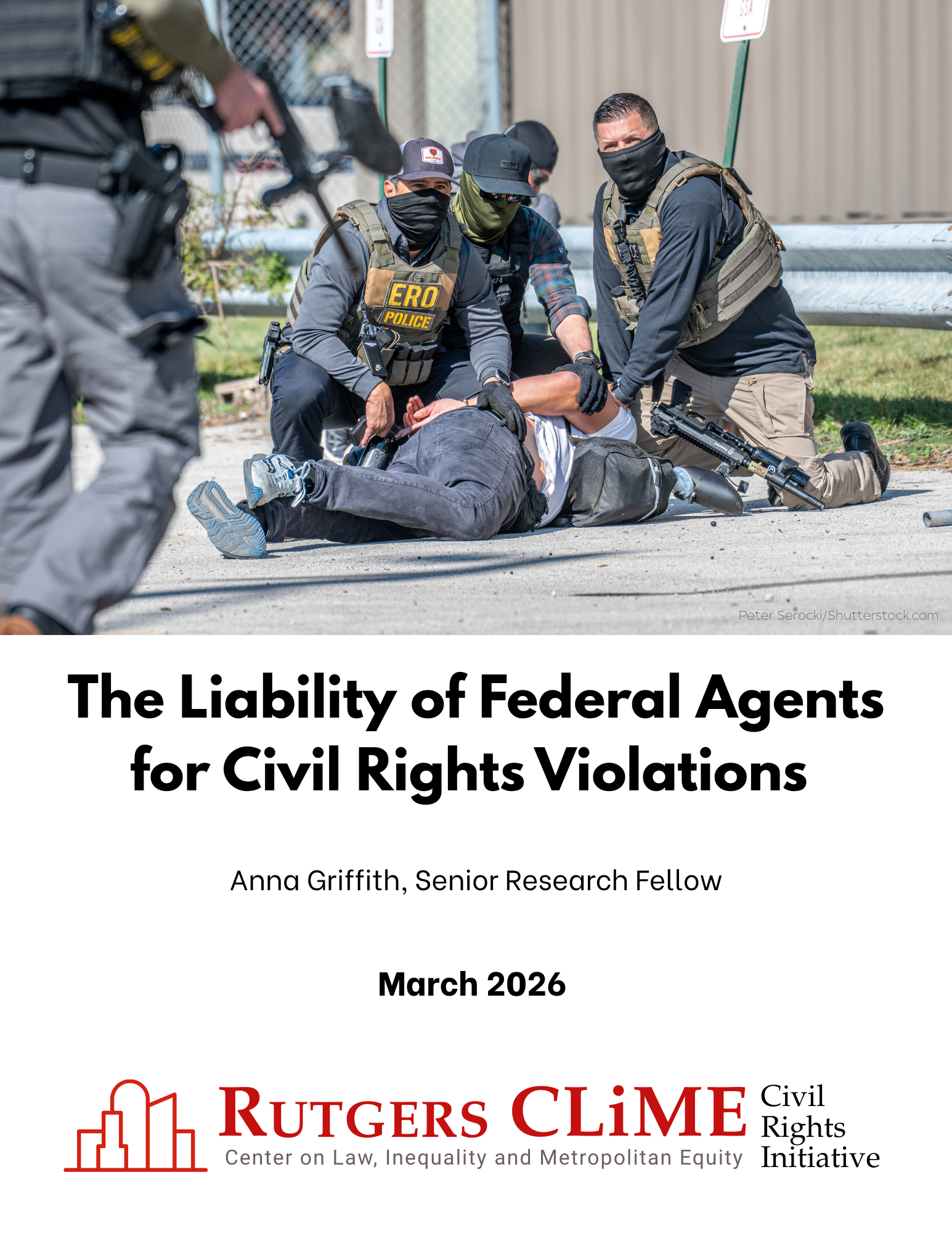
Can people sue federal agents for police brutality? In this memorandum, CLiME explores the very limited bases for finding ICE agents civilly liable for excessive force or deprivation of civil rights. The main issues involve:
restrictive federal legal standards and barriers to bringing a claim
unbridled and undue deference afforded to federal law enforcement agents on the job, and
underdeveloped state laws that have yet to provide legitimate alternatives to weak federal causes of action.
Courts appear to be generally hostile to government liability and the costs of accountability against federal agents. As a result, unlike police brutality by state and local law enforcement, legal remedies against ICE and other federal law enforcement are largely unavailable. Some scholars have proposed ways to close this legal gap, so far without success.

Rewriting Racial Inequality: The State of Civil Rights Law under Trump documents the second Trump administration’s blueprint for radically transforming how the federal government views and enforces civil rights. The new legal order taking shape upends Reconstruction-era understandings of equal protection and related federal statutes while recasting the modern Civil Rights Movement as a defense against anti-white race discrimination. Our close and comprehensive examination of executive orders, enforcement activity and litigation since January 20, 2025, organizes the Trump administration’s approach into four pillars: (1) Redefining racial discrimination, (2) Dismantling the institutional framework for government support of racial equity and cancelling existing investigations, (3) Enforcing policy priorities through defunding and fining institutions, and (4) Encouraging racial gerrymandering of congressional districts in the guise of political gerrymandering.
Rewriting Racial Inequality offers a rare focus on issues of racial equality as a fundamental interest, anti-Black racism and the Trump administration’s civil rights playbook at the crossroads of antidiscrimination law. This critical evaluation is intended as a resource and will be updated in six months.

The Supreme Court’s decision in Students for Fair Admissions v. Harvard reshaped the constitutional landscape of higher education while leaving important questions of educational mission unanswered. By undermining diversity as a compelling interest under strict scrutiny judicial review, the Court dismantled the decades-long framework under which universities adopted admissions practices in pursuit of self-defined institutional goals. That model may fit elite private institutions like Harvard or UNC, but it fails to capture the full spectrum of American higher education.
This brief proposes that land-grant universities possess a distinct institutional interest in cultivating a diverse student body. This interest is grounded in their statutory mission, the historical purpose of the Morrill Acts, and the judicial deference traditionally afforded to congressional mandates that create and continue to govern land-grant institutions.
SFFA’s reasoning may be too rigid to accommodate the genuine diversity of institutional missions in American higher education. Recognizing this doctrinal blind spot is only the beginning of a broader scholarly conversation.

This report analyzes the compliance challenges public universities face since the issuance of several executive orders that threaten investigation and defunding for a broad range of activities associated with “DEI” and other undefined terms. In Part I, we examine the language of the federal directives in light of universities’ historic obligations and current circumstances. Many institutions have so far chosen some version of either pre-emptive obedience, wait-and-see inaction or offensive defiance. We suggest that institutions will face some combination of four possible courses of action: continue to obey civil rights law, anticipate new standards, manage risks and defend current practices.
Schools’ circumstances are not uniform. Yet all must conform to current legal standards, which are often inconsistent with the new federal policy directives. To clarify, this report sets out the existing state of the law since Students for Fair Admissions, including the scope and limitations of that Supreme Court decision, the continued allowance of race-neutral means to achieve racially diverse learning environments and the applicable tests used by the Court under Title VI. Since many organizations and institutions have already challenged the federal administration in court, we conclude with an analysis of the legal defenses—mostly on First Amendment grounds—that have so far succeeded in securing injunctions against certain banned practices. Part II of this report sets out best practices universities across the United States have used to stay in compliance with civil rights law yet still maintain environments that are diverse, inclusive and consistent with equitable principles.
Urban renewal, a mid-century federal-local redevelopment program that transformed American cities and displaced millions of Black migrants from the South, was a race-conscious government policy responsible for the enduring suppression of Black wealth. Its racial history and character are untold in legal scholarship. This Article argues that the 25-year regime enacted in the Housing Act of 1949 was a response to the Great Migration of Black workers and families to northern, midwestern, and western cities. It was codified to interact with other segregation policies, such as highway construction, restrictive covenants, redlining, and public housing through the colorblind veneer of rational planning principles. Race planning created durable conditions of “racial bargaining,” the discounted value of wealth-producing transactions in segregated Black communities. Since its mid-century enactment, urban renewal federalized a race-conscious segregation policy that eluded civil rights remedies and framed contemporary urban development programs. This Article shows how this framework sustained the racial wealth gap at the core of this country’s continuing struggle with structural inequality.

New Jersey's Assembly Bill A4 represents a landmark effort to comply with the Mount Laurel Doctrine and the state's growing affordable housing crisis by reforming how municipalities meet their fair share housing obligations. At the heart of this legislation is a standardized formula that requires each municipality to calculate its present and prospective affordable housing needs, along with other factors like population growth, land, and income capacity. By decentralizing housing planning, A4 shifts responsibility to local governments from the state and gives them a ten-year window to meet their fair share housing obligations.

Discussions about Vice President Kamala’ Harris’ record as a progressive prosecutor have offered an opportunity to consider what the next president could do to help spur equitable criminal justice reform. While recognizing that policing is largely a local endeavor, it is important to identify how the next president can leverage existing federal programs to contribute to larger criminal justice reform and equity efforts. In this paper we propose that the next administration restructure the Justice Assistance Grants (JAG) and Community-Oriented Policing Services (COPS) grants in order to support community-based criminal justice programs (CCJP) to achieve equitable criminal justice reform. These programs, which emphasize partnerships between law enforcement, prosecutors, and non-law enforcement organizations, aim to reduce crime and recidivism through rehabilitation, mental health services, and social support. The proposal we offer draws inspiration from Vice President Kamala Harris’s "Back on Track" program, which successfully helped first-time nonviolent offenders avoid incarceration through alternative sentencing that focuses on rehabilitation. The paper argues that similar programs, if federally supported, could help contribute to equitable criminal justice reform by fostering trust between law enforcement and communities, reducing police brutality while also preventing crime and recidivism.

In June 2023, the Supreme Court in Students For Fair Admissions, Inc. v. President and Fellows Of Harvard College (“SFFA”) found that Harvard University’s and the University of North Carolina’s affirmative action admission policies unconstitutionally employed race-based discrimination, violating the Equal Protection Clause of the 14th Amendment.[1]
Beginning with its first constitutional review of affirmative action, the Court has consistently found that the only governmental interest compelling enough to warrant the use of race in admissions policies and decisions, and thus satisfy strict scrutiny judicial review, is the institution’s interest in “obtaining the educational benefits that flow from an ethnically diverse student body.”[2] Before this first opinion in Regents of Univ. of Cal. v. Bakke, affirmative action initiatives were a “response to the legacy of Jim Crow segregation and, by extension, slavery. It was an outgrowth of the civil-rights initiatives… Diversity was part of the conversation, but it was only one of many reasons selective colleges employed affirmative action.”[3]

This is a structural analysis of police brutality, primarily the exercise of lethal force against unarmed persons, following the 2020 summer of racial reckoning when millions braved a virulent pandemic to protest the lack of legal and institutional accountability that predictably follows the police killings of unarmed black people. A consistent lack of accountability is what binds the individual acts to a design structure in which evidence clearly shows that black bodies are subordinated to some other systemic goal. We do not identify that goal, but we do evaluate the structure that produces predictable outcomes. Our aim is to set out much of the reform landscape—the issues, approaches and proposals from law to policy—and to evaluate them on structural grounds.
Over the last three years, St. Louis County municipalities have chronically violated the constitutional rights of indigent citizens by issuing unreasonable amounts of traffic tickets – tickets accompanied by slews of hefty fines and court costs. When indigent citizens are unable to pay the aforementioned, they are thrown in jail for extended periods of time. Civil rights groups allege that these practices, which are performed solely as a means of funding municipal endeavors, have created the functional equivalent of debtor prisons. The Rutgers Center on Law in Metropolitan …

Presented November 21, 2014 as part of the Equity and Opportunity Studies Fellowship workshop series, a partnership between CLiME at the Rutgers Law School, and the Graduate School at Rutgers University-Newark
SUMMARY: Title VIII of the Civil Rights Act of 1968, as amended (Fair Housing Act or Act), prohibits discrimination in the sale, rental, or financing of dwellings and in other housing-related activities on the basis of race, color, religion, sex, disability, familial status, or national origin.1 HUD, which is statutorily charged with the authority and responsibility for interpreting and enforcing the Fair Housing Act and with the power to make rules implementing the Act, has long interpreted the Act to prohibit practices with an unjustified discriminatory effect, regardless of whether there was an intent to discriminate. The eleven federal courts of appeals that have ruled on this issue agree with this interpretation. While HUD and every federal appellate court to have ruled on the issue have determined that liability under the Act may be established through proof of discriminatory effects, the statute itself does not specify a standard for proving a discriminatory effects violation. As a result, although HUD and courts are in agreement that practices with discriminatory effects may violate the Fair Housing Act, there has been some minor variation in the application of the discriminatory effects standard.
In the decade before and after the Supreme Court’s decision in Brown v. Board of Education, de jure segregation, the system of racially identified space, coalesced with formal land use planning to institutionalize de facto segregation in the city and suburbs of New Orleans, notwithstanding some of the most considerable early antisegregation forces in the nation’s history. Although the actual geographic fault lines changed over time, the basic color scheme did not. Race-neutral land use regulation reproduced the patterns of racial inequality that slavery, Jim Crow, and segregation …
EXECUTIVE SUMMARY: This report presents results from the first phase of the latest national Housing Discrimination Study (HDS2000), sponsored by the Department of Housing and Urban Development (HUD) and conducted by the Urban Institute. These results are based on 4,600 paired tests, conducted in 23 metropolitan areas nationwide during the summer and fall of 2000. In a paired test, two individuals—one minority and the other white—pose as otherwise identical homeseekers, and visit real estate or rental agents to inquire about the availability of advertised housing units. This methodology provides direct evidence of differences in the treatment minorities and whites experience when they search for housing.
CLiME’s Civil Rights Initiative is a research repository of careful thinking about civil rights law in the 21st century. We aim to clarify differences in the doctrinal struggle over the meaning of race and rights. Our work is intended as an aid to research on racial inequality in the United States.
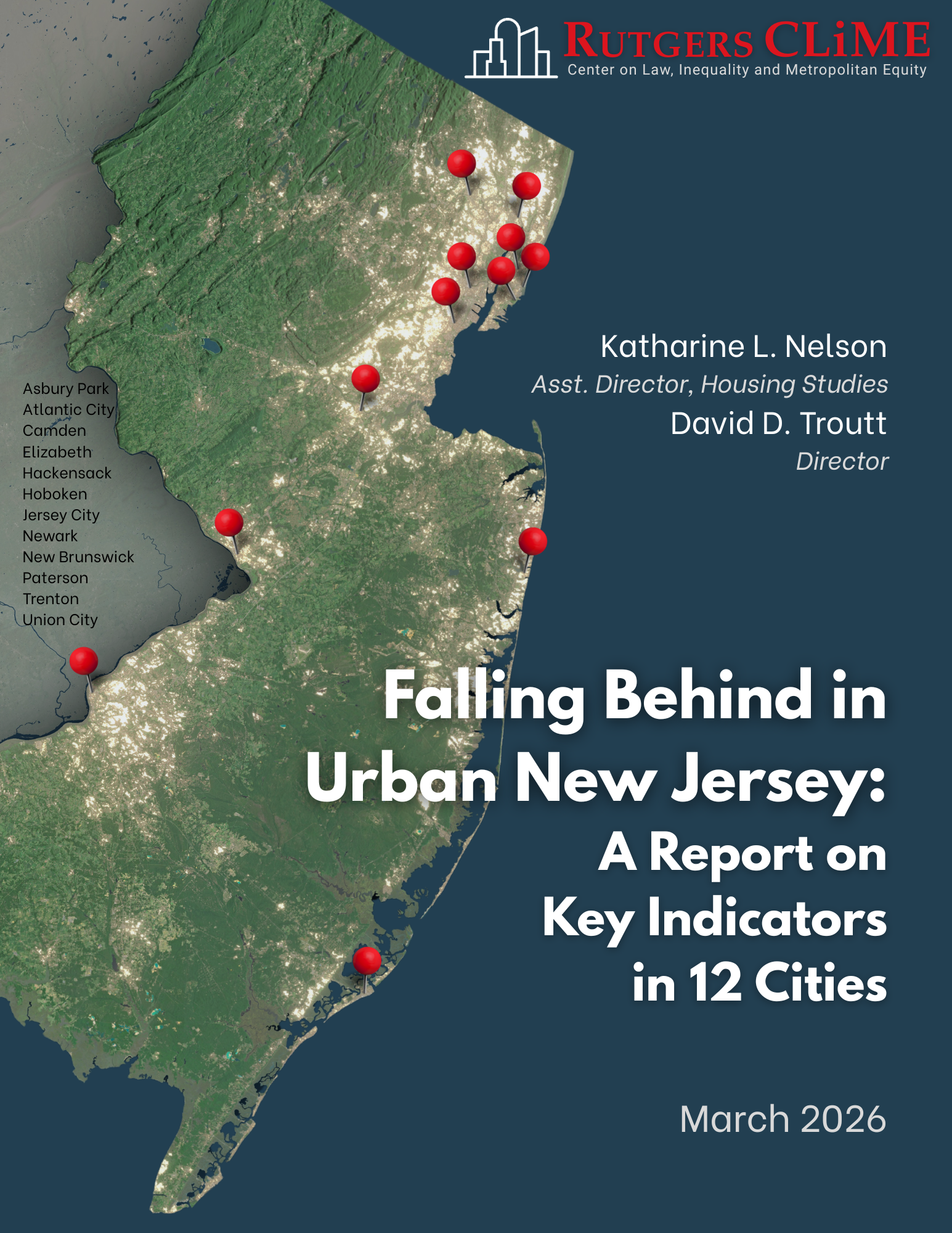
CLiME’s inaugural evaluation of 12 of New Jersey’s most populous cities reveals striking trends that reverse many of the last century’s assumptions about life in the Garden State. Despite dynamic changes in urban-suburban demographics, housing and job growth, one overriding fact prevails: economic inequality has hardened between cities and suburbs and within and across cities. We looked at social and economic trends in the state’s 12 most populous cities – Newark, Jersey City, Paterson, Hoboken, Union City, Hackensack, Asbury Park, New Brunswick, Trenton, Camden and Atlantic City – and found:
Urban population growth and residential development now outpaces the rest of the state.
The 12 cities are home to many working-class and immigrant residents, and more than half households struggle to make ends meet.
The 12 cities are home to the state’s poorest children, with poverty rates as high as 48 percent.
A lack of affordable housing is a problem statewide, but it’s especially pronounced in the gentrifying cities of the NY metro.
Read more to learn how these factors play out differently in different parts of the state and our recommendations for enhancing the economic prospects of New Jersey residents.
Can people sue federal agents for police brutality? In this memorandum, CLiME explores the very limited bases for finding ICE agents civilly liable for excessive force or deprivation of civil rights. The main issues involve:
restrictive federal legal standards and barriers to bringing a claim
unbridled and undue deference afforded to federal law enforcement agents on the job, and
underdeveloped state laws that have yet to provide legitimate alternatives to weak federal causes of action.
Courts appear to be generally hostile to government liability and the costs of accountability against federal agents. As a result, unlike police brutality by state and local law enforcement, legal remedies against ICE and other federal law enforcement are largely unavailable. Some scholars have proposed ways to close this legal gap, so far without success.
This is a structural analysis of police brutality, primarily the exercise of lethal force against unarmed persons, following the 2020 summer of racial reckoning when millions braved a virulent pandemic to protest the lack of legal and institutional accountability that predictably follows the police killings of unarmed black people. A consistent lack of accountability is what binds the individual acts to a design structure in which evidence clearly shows that black bodies are subordinated to some other systemic goal. We do not identify that goal, but we do evaluate the structure that produces predictable outcomes. Our aim is to set out much of the reform landscape—the issues, approaches and proposals from law to policy—and to evaluate them on structural grounds.

In Tiny Houses in the City of Newark, Rutgers doctoral candidate Lenore Pearson studies innovative tiny house programs underway in Detroit, Michigan and analyzes their prospective application in Newark in a fascinating memorandum about unique urban housing solutions.