
Equitable Growth
Cities and regions compete for growth in population, economic development and residential construction, but the redevelopment that follows can reinforce existing inequality. Policies that promote equitable growth ensure that the benefits of growth reach the most vulnerable people in a community. Equitable growth can have a transforming effect on the quality of all residents’ lives and undo longstanding patterns of inequality. Our reports on equitable growth highlight the many ways fairness can inform the law and policy of place to maximize the public benefit of public resources.
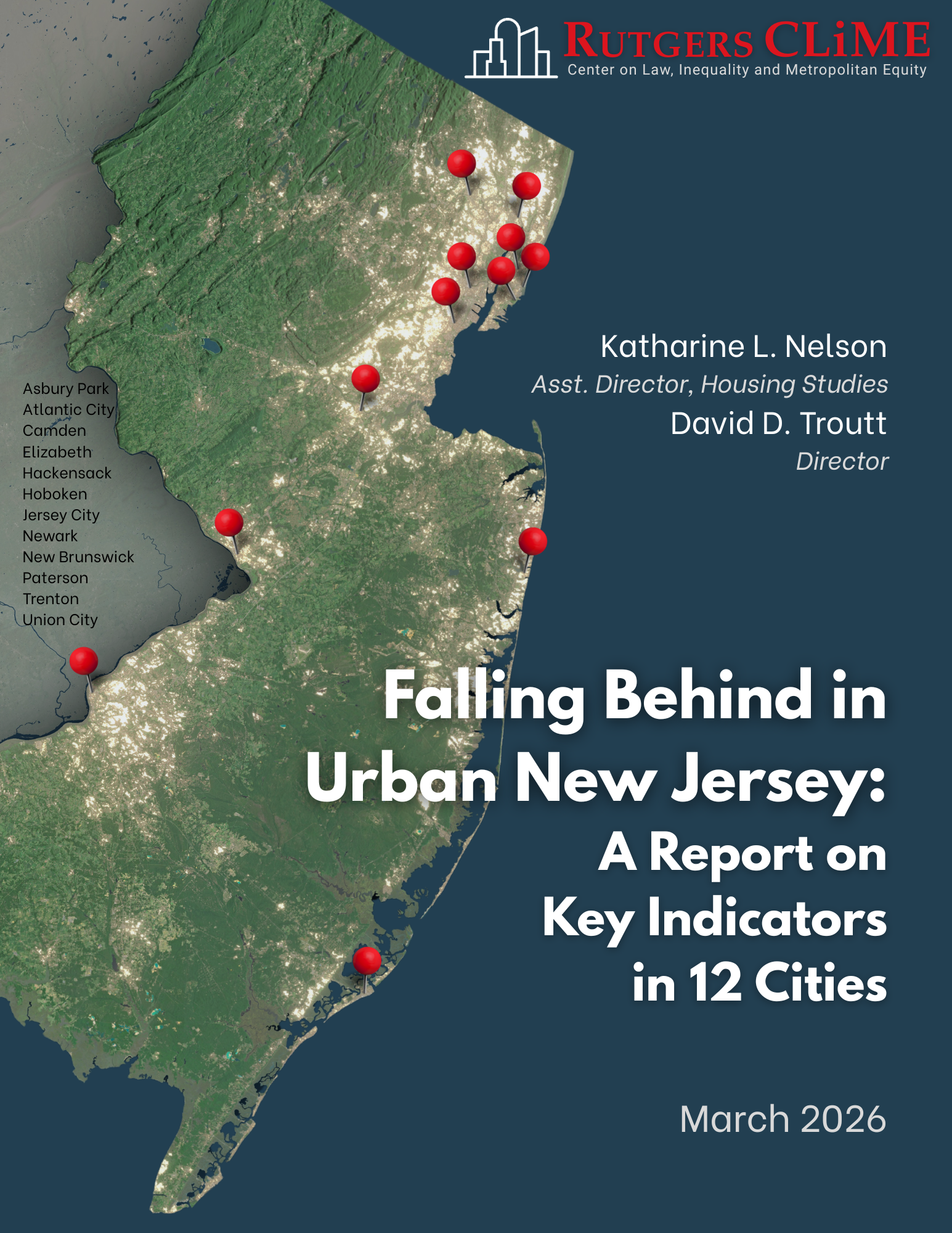
CLiME’s inaugural evaluation of 12 of New Jersey’s most populous cities reveals striking trends that reverse many of the last century’s assumptions about life in the Garden State. Despite dynamic changes in urban-suburban demographics, housing and job growth, one overriding fact prevails: economic inequality has hardened between cities and suburbs and within and across cities. We looked at social and economic trends in the state’s 12 most populous cities – Newark, Jersey City, Paterson, Hoboken, Union City, Hackensack, Asbury Park, New Brunswick, Trenton, Camden and Atlantic City – and found:
Urban population growth and residential development now outpaces the rest of the state.
The 12 cities are home to many working-class and immigrant residents, and more than half households struggle to make ends meet.
The 12 cities are home to the state’s poorest children, with poverty rates as high as 48 percent.
A lack of affordable housing is a problem statewide, but it’s especially pronounced in the gentrifying cities of the NY metro.
Read more to learn how these factors play out differently in different parts of the state and our recommendations for enhancing the economic prospects of New Jersey residents.

The Other Cities: Migration and Gentrification in Jersey City, Newark and Paterson describes housing trends and neighborhood transitions in three mid-sized North Jersey cities that elude conventional descriptions of gentrification. All three have experienced population growth, increased immigration, loss of Black residents and a persistent lack of housing affordability. We describe their particular dynamics three ways: "Bedroom City", "Jobless Gentrification" and "Migrant Metro." Jersey City is the “Bedroom City” where population growth and higher prices are associated with its proximity to jobs across the Hudson River in New York City. Newark is in the midst of “Jobless Gentrification” where investment in expensive market-rate new housing and investor-led renovations raise prices without the corresponding job growth seen in traditional gentrification. Paterson is the “Migrant Metro”, a species of municipalities that have become mosaics of working-class immigration whose density alone—not jobs or new housing—has intensified a lack of affordability. These characteristics distinguish them from traditionally gentrifying cities, but their traits are important bellwethers of urban life across the U.S.

This is a report about how cities can better organize and manage their data about the property they own in order to promote transparency and advance critical policymaking. Newark, like many legacy cities, owns hundreds of parcels through tax foreclosure and abandonment that can be put to more productive use and even generate needed revenue. Because of different inputs from different departments, its property data system contained duplication and gaps that prevented policymakers and stakeholders from getting a clear picture of these public assets. In partnership with city staff, CLiME helped to resolve the data organization problem and set property management on a new, more accurate and user-friendly course. Along the way, we learned details about the nature and amount of city-owned properties, how they’re zoned and where they’re located. We concluded that much more of this significant inventory can and should be put to work advancing long-held goals of equitable development. We built three demonstrations to simulate this usage that cover three major areas of policy: affordable housing production, commercial and industrial development and green space/environmental risk mitigation. Each of these is an area in which the Baraka administration is already active in setting aggressive policies. Some of those policies already make use of the asset of city-owned land. Until recently, it was impossible to see the scope of particular uses because the data did not readily permit it. Now the data is cleaner and clearer.
Individual break-out reports from the full report are also available:
As the New Jersey Supreme Court recently noted in Malanga v. Township of West Orange, municipalities can sell or improve upon public property in a number of ways.¹ However, a redevelopment designation appears to be the best way for a municipality to maintain the greatest degree of control over the future of a given parcel, in terms of retaining ownership, choosing a developer and deciding the use to which the parcel will be put. Without such a designation, in order to facilitate non-publicly funded development of city-owned property, a city would have to auction property off to the highest bidder at an open public auction, a risky process over which the city could easily lose control.² Furthermore, though a municipality can impose conditions on the sale and restrictions on the use of property sold at auction,³ it cannot convey property for nominal consideration without a redevelopment designation, unless the property is conveyed to a very narrow set of noncommercial entities.⁴

Few race-conscious public policies displaced African-American individuals and families like the federal urban renewal program from 1949 to 1974. Hundreds of cities spent millions of taxpayer dollars engaging in "slum removal" of entire neighborhoods only recently occupied by Blacks from the Great Migration. Their forced relocation—almost always without statutorily promised relocation expenses and assistance—was a harbinger of the modern ghetto and a blueprint for urban planning approaches that continue to this day.
As part of CLiME's Displacement Project, we began a broad inquiry into urban renewal in 2021. The results will follow in the form of academic papers, policy briefs and here, a growing archive of hard-to-find data on the program's implementation in select U.S. cities. CLiME Fellow and Bloustein graduate Erica Copeland assembled variables on the location, demographic variables and costs associated with primarily African-American displacement for a select period of time. We hope this contributes to a growing body of academic research on an under-appreciated aspect of systemic racism carried out by the federal and local governments at midcentury, whose wealth-retarding effects persist.
This report and accompanying matrix are a critical evaluation of New Jersey’s tax incentives programs through the policy lens of equitable growth. Persistent inequality between New Jersey’s communities and households hurts all of New Jersey. We assumed that the expenditure of taxpayer dollars for private economic gain should further a public interest in making weaker markets stronger—i.e., equitable growth. We identified every state tax incentive that contained some aspect of economic fairness and analyzed each for how well it contributed to producing equitable growth. As the matrix at the end of the report shows, we found few gains and many lost opportunities.
If economic development broadly represents New Jersey’s interests in promoting economic welfare, then equitable economic development refocuses state policy on the state’s interest in improving economic welfare in the places where market need is greatest. Since many of these needs converge in communities of the state that have struggled with disinvestment and undernourished markets for many years, we believe a critical public purpose is served when the state steps in to revitalize markets where no one else will. This represents a policy of equitable economic development, an expansion of growth and opportunity.

Making Newark Work for Newarkers is the full report of the Rutgers University-Newark Project on Equitable Growth in the City of Newark, written by CLiME and incorporating research conducted in conjunction with a university working group whose work began last April. We viewed the goal of equitable growth first in the context of housing issues before expanding to think about the fabric of community life and economic opportunity in the city.

The Rutgers University-Newark Project on Equitable Growth was formed as a team of university researchers led by CLiME to provide research and recommendations about spreading the benefits of potential economic growth to all wards and neighborhoods in the City of Newark. Although housing and housing-related issues dominated our work, we viewed the task more broadly and asked: How does a working-class city in the midst of economic interest from a fast- growing metropolitan region harness …
What would an equitable DC look like? Communities of color have faced decades of systemic racism and discriminatory policies and practices. These actions have barred people of color from certain jobs and neighborhoods and from opportunities to build wealth, leaving a legacy that persists today. If the nation’s capital were free of its stark racial inequities, it could be a more prosperous and competitive city—one where everyone could reach their full potential and build better lives for themselves and their families.
Washington, DC, is one of most racially segregated cities in the United States, stemming from public policies and private actions that once limited where black residents could live, whether they could secure mortgages, and whom they could buy homes from. Today, Wards 4, 5, 7, and 8 on the east have a majority of black residents, and Wards 2, 3, and 6 on the west are majority white. About half of Hispanic residents live in Wards 1 and 4.
Whereas many U.S. cities have experienced a post-recession economic revival, the accompanying run-up in housing costs is threatening to undermine this success by pricing workers out of cities, lengthening commutes, and diminishing livability, the report notes. As a result, local officials are turning to inclusionary zoning (IZ) as a way to combat the shortage of housing that is affordable to moderate- and lower-income workers.
IZ policies take a market-based approach to affordable housing development by requiring or incentivizing the creation of below-market-rate units in exchange for approval of a market-rate project. Inclusionary zoning leverages private development to achieve a public benefit.

Presented April 8, 2016 as part of the Equity and Opportunity Studies Fellowship writing seminar series, a partnership between CLiME at the Rutgers Law School, and the Graduate School at Rutgers University-Newark.
"In this post we will explore the degree of income inequality seen in New Jersey’s municipalities. Using the same process as in our previous analysis where we explored the Gini Index and 80/20 Household Income Ratio of US counties, here we can get a more granular view of inequality seen within our counties.
Using the interactive map and table feature below, we can see the Gini Index, the 80/20 Household Income Ratio, and the income limits for the 20% and 80% cutpoints for every New Jersey municipality. This information, along with margins of error are displayed when hovering over or clicking a municipality on the maps. Options for filtering the maps and table are found on the right-hand side of the feature."

Presented December 12, 2015 as part of the Equity and Opportunity Studies Fellowship writing seminar series, a partnership between CLiME at the Rutgers Law School, and the Graduate School at Rutgers University-Newark.
The achievement gap is often defined as the difference in academic achievement of minority and/or low-income students and their White and/or more affluent peers. Its status is evaluated through state standardized assessments, mandated under the No Child Left Behind Act (NCLB), as well as the National Assessment of Educational Progress (NAEP).
"According to the latest United Way of Northern New Jersey ALICE Report, 1.2 million households in New Jersey are unable to afford the state’s high cost of living. That number includes those living in poverty and the population called ALICE, which stands for Asset Limited, Income Constrained,Employed.
The ALICE study provides county-by-county and town-level data; cost of living calculations for six family size variations; analysis of how many households are living paycheck to paycheck; and the implications for New Jersey’s future economic stability."
Since the economic collapse of 2008, American citizens have grown increasingly skeptical oftheir government’s ability to pass socially and economically beneficial legislation. As citizens criticize large-scale government entities, such as the federal government or state legislatures, lower-level politicians have attempted to keep the masses at bay by passing legislation that will appease the voters in their districts. However, much of this newfound legislation is at odds with the policymaking efforts of their superior levels of government. In particular, over the last three years …
Municipal court cases account for the bulk of all legal filings and are often the only interaction that many people have with the judicial system, yet there is a significant lack of research on the impact of municipal courts on our daily lives. Scholarly discourse on the provision of municipal services tends to focus on municipal services which play a key role in our day to day lives such as education, waste management, or park maintenance. While the role of municipal courts in our daily lives may not be as visible as other municipal services, they serve a key judicial and municipal …
ABSTRACT: We characterize the effects of neighborhoods on children’s earnings and other outcomes in adulthood by studying more than five million families who move across counties in the U.S. Our analysis consists of two parts. In the first part, we present quasi-experimental evidence that neighborhoods affect intergenerational mobility through childhood exposure effects. In particular, the outcomes of children whose families move to a better neighborhood – as measured by the outcomes of children already living there – improve linearly in proportion to the time they spend growing up in that area. We distinguish the causal effects of neighborhoods from confounding factors by comparing the outcomes of siblings within families, studying moves triggered by displacement shocks, and exploiting sharp variation in predicted place effects across birth cohorts, genders, and quantiles.
ABSTRACT: The Moving to Opportunity (MTO) experiment offered randomly selected families living in high poverty housing projects housing vouchers to move to lower-poverty neighborhoods. We present new evidence on the impacts of MTO on children’s long-term outcomes using administrative data from tax returns.
We find that moving to a lower-poverty neighborhood significantly improves college attendance rates and earnings for children who were young (below age 13) when their families moved. These children also live in better neighborhoods themselves as adults and are less likely to become single parents.
Location matters – enormously. If you’re poor and live in the New York area, it’s better to be in Putnam County than in Manhattan or the Bronx. Not only that, the younger you are when you move to Putnam, the better you will do on average. Children who move at earlier ages are less likely to become single parents, more likely to go to college and more likely to earn more.
Every year a poor child spends in Putnam County adds about $150 tohis or her annual household income at age 26, compared with a childhood spent in the average American county. Over the course of a full childhood, which is up to age 20 for the purposes of this analysis, the difference adds up to about $3,100, or 12 percent, more in average income as a young adult.

The low wage labor market today is characterized by the increased utilization of part-time and temporary workers with volatile work schedules. These practices shift business risk to workers, and place their lives in a constant state of instability. Unpredictable work schedules prevent workers from pursuing supplemental employment, training, or attending to caregiver responsibilities. This diminishes the future economic potential of workers, effectively creating a worker caste system, and establishing a structural barrier to income mobility.
The ultimate objective of regional equity activities is to reform those policies and practices that create and sustain social, racial, economic and environmental inequalities among cities, suburbs and rural areas -- and to bridge the gap between marginalized people and places and the region’s structures of social and economic opportunity. In my book Inside Game/Outside Game, I described three domains of work …
In August 2014, a Ferguson, Missouri, policeman shot and killed an unarmed black teenager. Michael Brown’s death and the resulting protests and racial tension brought considerable attention to that town. Observers who had not been looking closely at our evolving demographic patterns were surprised to see ghetto conditions we had come to associate with inner cities now duplicated in a formerly white suburban community: racially segregated neighborhoods with high poverty and unemployment, poor student achievement in overwhelmingly black schools, oppressive policing, abandoned homes, and community powerlessness.
Media accounts of how Ferguson became Ferguson have typically explained that when African Americans moved to this suburb (and others like it), “white flight” followed, abandoning the town to African Americans who were trying to escape poor schools in the city. The conventional explanation adds that African Americans moved to a few places like Ferguson, not the suburbs generally, because prejudiced real estate agents steered black home buyers away from other white suburbs. And in any event, those other suburbs were able to preserve their almost entirely white, upper-middle-class environments by enacting zoning rules that required only expensive single family homes, the thinking goes.
Presented October 10, 2014 as part of the Equity and Opportunity Studies Fellowship workshop series, a partnership between CLiME at the Rutgers Law School, and the Graduate School at Rutgers University-Newark
ABSTRACT: In this article, Genevieve Siegel-Hawley illuminates the challenges and opportunities posed by demographic change in suburban school systems. As expanding student populations stretch the enrollment capacities of existing schools in suburban communities, new schools are built and attendance lines are redrawn. This redistricting process can be used either to foster school diversity or to exacerbate racial isolation. Drawing on data from the U.S. Census, the National Center for Education Statistics (NCES), and the school district, along with mapping software from Geographic Information Systems (GIS), Siegel-Hawley examines the relationship between overcrowding, racial isolation, and the original, proposed, and final high school attendance zones in a changing suburban district. Findings indicate that school officials responsible for the rezoning process failed to embrace the growing diversity of the school system, choosing instead to solidify extreme patterns of racial isolation within high school attendance areas. The segregative impact of the district's new attendance zones may be subject to legal scrutiny, a consequence that could—and should—discourage other school systems from adopting similarly harmful redistricting policies.
In a 2011 public opinion poll, The Pew Charitable Trusts asked Americans how important they thought a number of factors were in determining whether people in the United States get ahead or fall behind economically. More than 80 percent of respondents identified factors such as hard work, personal ambition, and access to education as key drivers of upward mobility, while less than half viewed growing up in a good neighborhood as an important factor. On the contrary, respondents strongly agreed that a young person with drive, ambition, and creativity growing up in a poor neighborhood is more likely to get ahead economically than someone who grew up in a more affluent neighborhood but lacks those personal attributes.
Contrary to these perceptions, however, evidence is building that location actually matters a great deal and that Americans' economic mobility prospects vary by state, locality, and even neighborhood. This report adds to the growing body of research as it examines economic mobility across 96 U.S. metropolitan areas and the role of place in Americans' prospects of moving up or down the economic ladder.
Connectivity is the measurement of how easily one can travel in and out of a place. Connectivity is what makes a commute to work, or a simple trip to the grocery store, possible. A state can have one thousand fancy trains. But, if you have no car, none of those trains stop in your town, and there are no bus stops either, you’re not going anywhere. Conversely, your hometown could be the most well-connected and transit- friendly town on the planet. But, if the job you want is in a town where there is no transit, you cannot get to work.
Newark’s story is one that has been told and retold. Once a bustling industrial power and an engine of the middle class, in recent decades the city has been wounded by racial strife, suburban flight, and industrial abandonment. From a high in 1948 of nearly half a million, Newark’s population today has plummeted to 277, 540. The intersection of Broad St. and Market St., once the busiest retail nexus in the country, is now a shadow of its former self. More than a quarter of Newark’s people are in poverty, and its black population is hypersegregated from its white population …
INTRODUCTION: In 1875, New Jersey’s legislature and citizenry committed themselves constitutionally to a “thorough and efficient system of free public schools for the instruction of all the children in the State between the ages of five and eighteen years.”
The fact that this education clause was placed in the Taxation and Finance article of the state’s constitution and imposed responsibility on the legislature to provide for the “maintenance and support” of the statewide public education system made clear that funding was considered a key part of the state’s responsibility. Yet, it has taken more than 40 years of litigation, still ongoing, in the state courts to assure that New Jersey’s poorest urban school districts have adequate funding to try to meet their weighty educational obligations.
EXECUTIVE SUMMARY: New Jersey has a curious status regarding school desegregation. It has had the nation’s most venerable and strongest state law prohibiting racially segregated schooling and requiring racial balance in the schools whenever feasible. Yet, it simultaneously has had one of the worst records of racially imbalanced schools.
In 1881, a New Jersey statute was enacted that prohibited segregated schooling based on race, one of the very first such laws in the nation.1 In 1947, New Jersey adopted a state constitutional provision that specifically prohibited segregation in the public schools.2 It is the only state with such an explicit provision. Connecticut’s state constitution, the next strongest, bars “segregation or discrimination in the exercise or enjoyment of his or her civil or political rights,” but it does not specify the public schools.
Localism
CLiME’s inaugural evaluation of 12 of New Jersey’s most populous cities reveals striking trends that reverse many of the last century’s assumptions about life in the Garden State. Despite dynamic changes in urban-suburban demographics, housing and job growth, one overriding fact prevails: economic inequality has hardened between cities and suburbs and within and across cities. We looked at social and economic trends in the state’s 12 most populous cities – Newark, Jersey City, Paterson, Hoboken, Union City, Hackensack, Asbury Park, New Brunswick, Trenton, Camden and Atlantic City – and found:
Urban population growth and residential development now outpaces the rest of the state.
The 12 cities are home to many working-class and immigrant residents, and more than half households struggle to make ends meet.
The 12 cities are home to the state’s poorest children, with poverty rates as high as 48 percent.
A lack of affordable housing is a problem statewide, but it’s especially pronounced in the gentrifying cities of the NY metro.
Read more to learn how these factors play out differently in different parts of the state and our recommendations for enhancing the economic prospects of New Jersey residents.
Connectivity is the measurement of how easily one can travel in and out of a place. Connectivity is what makes a commute to work, or a simple trip to the grocery store, possible. A state can have one thousand fancy trains. But, if you have no car, none of those trains stop in your town, and there are no bus stops either, you’re not going anywhere. Conversely, your hometown could be the most well-connected and transit- friendly town on the planet. But, if the job you want is in a town where there is no transit, you cannot get to work.
Newark’s story is one that has been told and retold. Once a bustling industrial power and an engine of the middle class, in recent decades the city has been wounded by racial strife, suburban flight, and industrial abandonment. From a high in 1948 of nearly half a million, Newark’s population today has plummeted to 277, 540. The intersection of Broad St. and Market St., once the busiest retail nexus in the country, is now a shadow of its former self. More than a quarter of Newark’s people are in poverty, and its black population is hypersegregated from its white population …
This paper will demonstrate how variations in historical development patterns in the Borough of Paramus and the City of Garfield have resulted in striking differences in terms of the economic and educational opportunities currently afforded the residents of each. Part I will consist of an Equity Audit highlighting the differences in life outcomes between the residents of these municipalities. Part II, Opportunity Factors, will discuss how disparities in wealth and the socioeconomic segregation of schoolchildren affect opportunity in each community. Part III, Remedies, …
While New Jersey is one of the United States’ most populous states, it is simultaneously one of its wealthiest. In other respects, however, New Jersey closely mirrors the overall demographic make-up of the United States, specifically in terms of race. When looking at New Jersey on a more micro and municipal level the state is equally illustrative of insidious problems plaguing the country as a whole, most notably the inequitable and disharmonious way in which wealth and race statistics are consolidated and segregated across New Jersey’s 566 municipalities, due in …
What is the ‘American Dream’? When asked that question, many may envision houses with white picket fences coupled with children, hardworking parents and let us not forget the dog. A quite modest picture is painted, however the question and its subsequent answer that will have the most consequence for the future of America revolves around who and not what. Who is able to achieve the ‘American Dream’? Is everyone afforded the same opportunity to achieve the ever so coveted ‘American Dream’? As we perform an equity analysis on cities and suburbs …
This paper will compare the townships of Maplewood and Irvington, New Jersey. Although the towns share a geographic border, the difference between the two communities is considerable. In Part I, I survey the financial differences and fairly typical Census measurements. In Part II, I will review how opportunity for class mobility is present or not present in each community. For this analysis, I am looking at how concentrated poverty in Irvington restricts mobility as compared to Maplewood where such hyper-segregation and concentrations of poverty do not exist.
ABSTRACT: After briefly discussing the problem of competition and the claims of new regionalists, this Article will track the development of school finance reform, including the recent success of plaintiffs in asserting claims seeking adequacy in education, rather than simply equity in funding. It will show that school districts’ traditional reliance on local property taxes has been effectively lessened by state equalization.
This Article will examine two states where significant changes in school equity occurred in the 1990s: Kentucky and Michigan. This Article will conclude by noting that some form of litigation strategy together with public education and organizing could advance the possibility of regional reform in other areas, such as municipal finance, regional land use and/or governance issues. Finally, the Article will argue that the collaboration necessary to build a school and municipal equity coalition can also be used to build a coalition on land use planning and regional governance.
ABSTRACT: Suburbanization and sprawl present new issues and challenges of regional inequity and equal opportunity. As awareness of the effects of the impacts of uneven and unhealthy development patterns grow, the debate for dealing with the fallout of sprawl is being taken up and policy agenda is emerging to address smart growth. With the emergence of the region rather than the city as the dominant economic and social geographic unit and key policy changes, the article propounds that the mistakes of the past fifty years can be reversed and regional equity achieved. The article makes it clear that life changes are largely determined by where one lives. The development patterns detailed in the article directly relate to an extreme inequality for poor people of color, but new factors are emerging that create a platform for addressing the inequality.
CLiME’s inaugural evaluation of 12 of New Jersey’s most populous cities reveals striking trends that reverse many of the last century’s assumptions about life in the Garden State. Despite dynamic changes in urban-suburban demographics, housing and job growth, one overriding fact prevails: economic inequality has hardened between cities and suburbs and within and across cities. We looked at social and economic trends in the state’s 12 most populous cities – Newark, Jersey City, Paterson, Hoboken, Union City, Hackensack, Asbury Park, New Brunswick, Trenton, Camden and Atlantic City – and found:
Urban population growth and residential development now outpaces the rest of the state.
The 12 cities are home to many working-class and immigrant residents, and more than half households struggle to make ends meet.
The 12 cities are home to the state’s poorest children, with poverty rates as high as 48 percent.
A lack of affordable housing is a problem statewide, but it’s especially pronounced in the gentrifying cities of the NY metro.
Read more to learn how these factors play out differently in different parts of the state and our recommendations for enhancing the economic prospects of New Jersey residents.
Few race-conscious public policies displaced African-American individuals and families like the federal urban renewal program from 1949 to 1974. Hundreds of cities spent millions of taxpayer dollars engaging in "slum removal" of entire neighborhoods only recently occupied by Blacks from the Great Migration. Their forced relocation—almost always without statutorily promised relocation expenses and assistance—was a harbinger of the modern ghetto and a blueprint for urban planning approaches that continue to this day.
As part of CLiME's Displacement Project, we began a broad inquiry into urban renewal in 2021. The results will follow in the form of academic papers, policy briefs and here, a growing archive of hard-to-find data on the program's implementation in select U.S. cities. CLiME Fellow and Bloustein graduate Erica Copeland assembled variables on the location, demographic variables and costs associated with primarily African-American displacement for a select period of time. We hope this contributes to a growing body of academic research on an under-appreciated aspect of systemic racism carried out by the federal and local governments at midcentury, whose wealth-retarding effects persist.
Connectivity is the measurement of how easily one can travel in and out of a place. Connectivity is what makes a commute to work, or a simple trip to the grocery store, possible. A state can have one thousand fancy trains. But, if you have no car, none of those trains stop in your town, and there are no bus stops either, you’re not going anywhere. Conversely, your hometown could be the most well-connected and transit- friendly town on the planet. But, if the job you want is in a town where there is no transit, you cannot get to work.
Newark’s story is one that has been told and retold. Once a bustling industrial power and an engine of the middle class, in recent decades the city has been wounded by racial strife, suburban flight, and industrial abandonment. From a high in 1948 of nearly half a million, Newark’s population today has plummeted to 277, 540. The intersection of Broad St. and Market St., once the busiest retail nexus in the country, is now a shadow of its former self. More than a quarter of Newark’s people are in poverty, and its black population is hypersegregated from its white population …
Soon after the initial shock of largest hurricane to ever hit the Jersey Shore began to dissipate, scholars, reporters and advocates began to look deeper at the implications of the disaster. Like Hurricane Katrina, Hurricane Sandy exposed fundamental inequities in our society that resulted in frightening racial and economic disparities between those devastated by the storm, and those less affected. We learned from Hurricane Katrina that “outsiders who wonder why residents ‘chose’ housing susceptible to flooding disregard the legacy of laws and hostility that excluded …
ABSTRACT: This paper develops a framework to study the effects of tax expenditures on intergenerational mobility using spatial variation in tax expenditures across the United States. We measure intergenerational mobility at the local (census commuting zone) level based on the correlation between parents’ and children’s earnings. We show that the level of local tax expenditures (as a percentage of AGI) is positively correlated with intergenerational mobility and that this correlation is robust to introducing controls for local area characteristics. To understand the mechanisms driving this correlation, we analyze the largest tax expenditures in greater detail. We find that the level and the progressivity of state income taxes are positively correlated with intergenerational mobility. Mortgage interest deductions are also positively related to intergenerational mobility. Finally, we find significant positive correlations between state EITC policy and intergenerational mobility. We conclude by discussing other applications of this methodology to evaluate the net benefits of tax expenditures.
This paper will demonstrate how variations in historical development patterns in the Borough of Paramus and the City of Garfield have resulted in striking differences in terms of the economic and educational opportunities currently afforded the residents of each. Part I will consist of an Equity Audit highlighting the differences in life outcomes between the residents of these municipalities. Part II, Opportunity Factors, will discuss how disparities in wealth and the socioeconomic segregation of schoolchildren affect opportunity in each community. Part III, Remedies, …
While New Jersey is one of the United States’ most populous states, it is simultaneously one of its wealthiest. In other respects, however, New Jersey closely mirrors the overall demographic make-up of the United States, specifically in terms of race. When looking at New Jersey on a more micro and municipal level the state is equally illustrative of insidious problems plaguing the country as a whole, most notably the inequitable and disharmonious way in which wealth and race statistics are consolidated and segregated across New Jersey’s 566 municipalities, due in …
Growing concerns about wealth inequality and the expanding racial wealth gap have in recent years become central to the debate over whether our nation is on a sustainable economic path. This report provides critical new information about what has fueled the racial wealth gap and points to policy approaches that will set our country in a more equitable and prosperous direction.
New research shows the dramatic gap in household wealth that now exists along racial lines in the United States cannot be attributed to personal ambition and behavioral choices, but rather reflects policies and institutional practices that create different opportunities for whites and African-Americans. So powerful are these government policies and institutional practices that for typical families, a $1 increase in average income over the 25-year study period generates just $0.69 in additional wealth for an African-American household compared with $5.19 for a white household. Part of this equation results from black households having fewer opportunities to grow their savings beyond what needed for emergencies.
What is the ‘American Dream’? When asked that question, many may envision houses with white picket fences coupled with children, hardworking parents and let us not forget the dog. A quite modest picture is painted, however the question and its subsequent answer that will have the most consequence for the future of America revolves around who and not what. Who is able to achieve the ‘American Dream’? Is everyone afforded the same opportunity to achieve the ever so coveted ‘American Dream’? As we perform an equity analysis on cities and suburbs …
This paper will compare the townships of Maplewood and Irvington, New Jersey. Although the towns share a geographic border, the difference between the two communities is considerable. In Part I, I survey the financial differences and fairly typical Census measurements. In Part II, I will review how opportunity for class mobility is present or not present in each community. For this analysis, I am looking at how concentrated poverty in Irvington restricts mobility as compared to Maplewood where such hyper-segregation and concentrations of poverty do not exist.
ABSTRACT: After briefly discussing the problem of competition and the claims of new regionalists, this Article will track the development of school finance reform, including the recent success of plaintiffs in asserting claims seeking adequacy in education, rather than simply equity in funding. It will show that school districts’ traditional reliance on local property taxes has been effectively lessened by state equalization.
This Article will examine two states where significant changes in school equity occurred in the 1990s: Kentucky and Michigan. This Article will conclude by noting that some form of litigation strategy together with public education and organizing could advance the possibility of regional reform in other areas, such as municipal finance, regional land use and/or governance issues. Finally, the Article will argue that the collaboration necessary to build a school and municipal equity coalition can also be used to build a coalition on land use planning and regional governance.
ABSTRACT: Suburbanization and sprawl present new issues and challenges of regional inequity and equal opportunity. As awareness of the effects of the impacts of uneven and unhealthy development patterns grow, the debate for dealing with the fallout of sprawl is being taken up and policy agenda is emerging to address smart growth. With the emergence of the region rather than the city as the dominant economic and social geographic unit and key policy changes, the article propounds that the mistakes of the past fifty years can be reversed and regional equity achieved. The article makes it clear that life changes are largely determined by where one lives. The development patterns detailed in the article directly relate to an extreme inequality for poor people of color, but new factors are emerging that create a platform for addressing the inequality.
Wealth
ABSTRACT: In this article, Genevieve Siegel-Hawley illuminates the challenges and opportunities posed by demographic change in suburban school systems. As expanding student populations stretch the enrollment capacities of existing schools in suburban communities, new schools are built and attendance lines are redrawn. This redistricting process can be used either to foster school diversity or to exacerbate racial isolation. Drawing on data from the U.S. Census, the National Center for Education Statistics (NCES), and the school district, along with mapping software from Geographic Information Systems (GIS), Siegel-Hawley examines the relationship between overcrowding, racial isolation, and the original, proposed, and final high school attendance zones in a changing suburban district. Findings indicate that school officials responsible for the rezoning process failed to embrace the growing diversity of the school system, choosing instead to solidify extreme patterns of racial isolation within high school attendance areas. The segregative impact of the district's new attendance zones may be subject to legal scrutiny, a consequence that could—and should—discourage other school systems from adopting similarly harmful redistricting policies.
INTRODUCTION: In 1875, New Jersey’s legislature and citizenry committed themselves constitutionally to a “thorough and efficient system of free public schools for the instruction of all the children in the State between the ages of five and eighteen years.”
The fact that this education clause was placed in the Taxation and Finance article of the state’s constitution and imposed responsibility on the legislature to provide for the “maintenance and support” of the statewide public education system made clear that funding was considered a key part of the state’s responsibility. Yet, it has taken more than 40 years of litigation, still ongoing, in the state courts to assure that New Jersey’s poorest urban school districts have adequate funding to try to meet their weighty educational obligations.
EXECUTIVE SUMMARY: New Jersey has a curious status regarding school desegregation. It has had the nation’s most venerable and strongest state law prohibiting racially segregated schooling and requiring racial balance in the schools whenever feasible. Yet, it simultaneously has had one of the worst records of racially imbalanced schools.
In 1881, a New Jersey statute was enacted that prohibited segregated schooling based on race, one of the very first such laws in the nation.1 In 1947, New Jersey adopted a state constitutional provision that specifically prohibited segregation in the public schools.2 It is the only state with such an explicit provision. Connecticut’s state constitution, the next strongest, bars “segregation or discrimination in the exercise or enjoyment of his or her civil or political rights,” but it does not specify the public schools.
Education attainment in the United States has a direct causal link with economic success. In 2012, the plurality of unemployed persons is represented by those with less than a high school diploma; higher level of education has an undeniable negative correlation with unemployment. Furthermore, those with little or no educational attainment who are employed find themselves making wages significantly less than those with a higher level. An individual’s level of educational attainment, therefore, has a direct correlation with his monetary earning, and distance away from …
The New Jersey Constitution states that, “[t]he Legislature shall provide for the maintenance and support of a thorough and efficient system of free public schools for the instruction of all the children in the State between the ages of five and eighteen years.” Although it has been about four decades since the first New Jersey decision that determined that relying solely on local property taxes was an unconstitutional way to fund public education, at-risk districts in New Jersey are still inadequate in comparison to their more affluent counterparts.
n the Baltimore region, a successful housing mobility program is providing families living in very disadvantaged inner city communities with a new home and a chance for a new life. Minority voucher holders in the federal Housing Choice Voucher Program (formerly titled Section 8) have often been limited to living in “voucher submarkets” where racial and economic segregation is high and opportunities are limited. The Baltimore Housing Mobility Program, a specialized regional voucher program operating with deliberate attention to expanding fair housing choice, has overcome some of the biggest barriers to using vouchers in suburban and city neighborhoods where opportunities are abundant. The program’s results-oriented approach has produced a replicable set of best practices for mobility programs while presenting an important model for reform of the national Housing Choice Voucher Program. This report, New Homes, New Neighborhoods, New Schools: A Progress Report on the Baltimore Housing Mobility Program, provides the first-ever comprehensive description of the program.