Posts tagged Inequality
Why is the "Rent So Damned High"?

Why is The “Rent So Damned High”? explores the drivers of high and rising rents and proposes a series of policies to address rental unaffordability in New Jersey and respond to changes at the federal level. Most experts say the chief explanation for high rents is an undersupply of housing and push a “build, build, build” strategy to bring rents down. Our findings challenge the consensus. Through a deep dive of academic and public research, we identified four primary drivers of high and rising rents: inflation, undersupply, widening inequality, and the consolidation and professionalization of landlords and real estate.

Federal policy is embracing building as the foremost solution to the affordability crisis. Trump’s Big Bill permanently expanded the country’s largest affordable housing production subsidy program, the Low-Income Housing Tax Credit (LIHTC). Meanwhile, deeper subsidy programs that can reach low-income renters are threatened with large cuts. To make housing affordable, we must also address stagnant incomes and the consolidation of homebuilders and landlords.

Read More
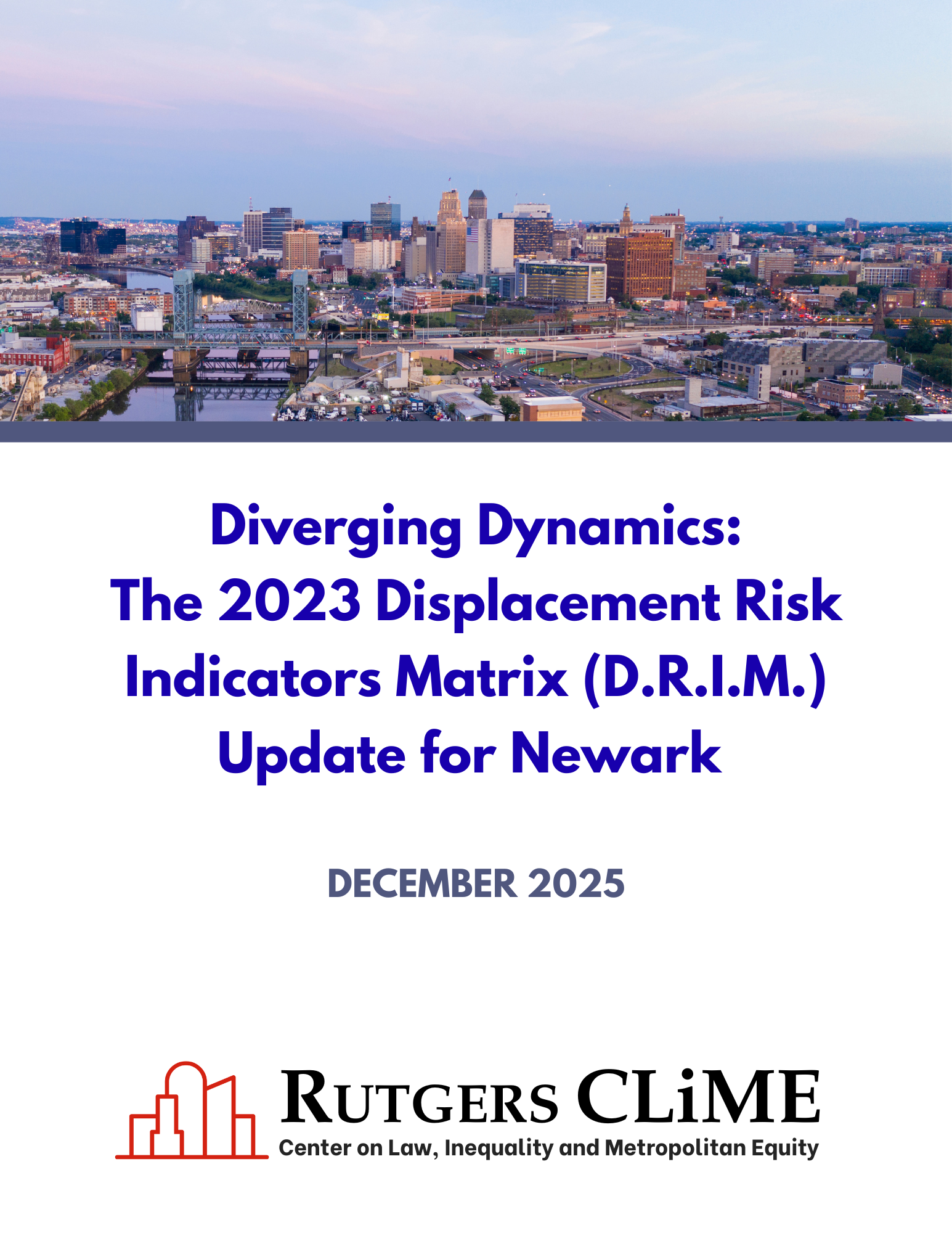
Diverging Dynamics: The 2023 Displacement Risk Indicators Matrix (D.R.I.M.) Update for Newark

Diverging Dynamics: The 2023 Displacement Risk Indicators Matrix (D.R.I.M.) Update for Newark explores how the risk of displacement in Newark has changed since 2010. Newark is experiencing the steady erosion of affordability as rents rise faster than incomes. In this latest installment of CLiME’s displacement analysis, diverging patterns of urban change are becoming clearer across wards with uneven but unmistakable signs of gentrification.

The East and Central Wards saw the most dramatic increases in new construction activity, the most rapidly rising rents, and the most pronounced increases in residents who are college-educated and/or affluent renters. The West Ward also shows signs of elevated renter vulnerability, with large increases in medium household incomes alongside rising rent burdens. The North Ward has very different housing market dynamics, with large increases in homeownership and much less residential construction. The South Ward shows the greatest signs of tenant vulnerability but also has the most affordable rental stock, compared to other parts of the city.

Read More
Rewriting Racial Equality: The State of Civil Rights Law under Trump

Rewriting Racial Inequality: The State of Civil Rights Law under Trump documents the second Trump administration’s blueprint for radically transforming how the federal government views and enforces civil rights. The new legal order taking shape upends Reconstruction-era understandings of equal protection and related federal statutes while recasting the modern Civil Rights Movement as a defense against anti-white race discrimination. Our close and comprehensive examination of executive orders, enforcement activity and litigation since January 20, 2025, organizes the Trump administration’s approach into four pillars: (1) Redefining racial discrimination, (2) Dismantling the institutional framework for government support of racial equity and cancelling existing investigations, (3) Enforcing policy priorities through defunding and fining institutions, and (4) Encouraging racial gerrymandering of congressional districts in the guise of political gerrymandering.

Under this framework, we explore how the Trump administration has built on prior conservative doctrinal developments in civil rights law to:

  • Offer a new interpretation of anti-discrimination based solely on an exaggerated application of Students for Fair Admissions v. Harvard that paints Black and brown people as the grantees of unmeritocratic preference and white people as the victims of discrimination;

  • Fire tens of thousands of federal employees and shuttered or incapacitated most federal agencies, offices, and programs focused on civil rights or equity;

  • Halt or cancel thousands of civil rights investigations, particularly claims of race discrimination, while prioritizing and opening new investigations for discrimination against white people and antisemitism;

  • Terminate, condition or freeze hundreds of billions of dollars in funding to states, universities, rural and low-income schools, nonprofits supporting vulnerable populations, groundbreaking scientific research, and programs explicitly created by Congress, all because they were identified as DEI-related and thus no longer effectuated Trump’s priorities; 

  • Present an erroneous legal finding of voter discrimination in order to force a hesitant state legislature to redistrict, resulting in a racial gerrymander.  

As a result, affected individuals, states, organizations, law firms and universities either sought resolution with the administration, hoping to avoid the public and financial costs of litigation, or fought the administration in court. Hundreds of challenges are ongoing in federal district courts throughout the country, with some claims successful in winning back their positions, grants, or constitutional protections, while others, denied relief often because of the Supreme Court, face the long-haul litigation battle. We chronicle these struggles for policymakers, researchers, students and the public at large.

The societal implications of these developments include the stereotyping of Black identity and the abandonment of racial remediation efforts; turmoil in the federal courts and a lack of consistent legal standards; a diminished federal rights infrastructure; and more culture war.

Rewriting Racial Inequality offers a rare focus on issues of racial equality as a fundamental interest, anti-Black racism and the Trump administration’s civil rights playbook at the crossroads of antidiscrimination law. This critical evaluation is intended as a resource and will be updated in six months.

Read More

Corporate Investors in Single Family Homes in Philadelphia

This report explores investor activity in Philadelphia, where corporate buyers are most active in parts of the city which are predominantly home to Black and Hispanic residents in West, North and Northeast Philadelphia. For this report, CLiME teamed up with the Reinvestment Fund and Housing Initiative at Penn, who are based in Philadelphia.

We identify the largest investors who are buying up the most single family homes, and who operate primarily as large-scale corporate landlords. The companies doing the purchasing changed during the pandemic, shifting from more local investors to those entering the market already active in other places.

We analyzed purchases of residential buildings before and during the pandemic, looking at sheriff sales, rental licensing, renovation permits, evictions, and code violations to determine the impact of these pur­chases on Philadelphia housing markets. We found that:

  • Larger corporate landlords were much more likely to evict tenants than smaller investors.

  • Larger in­vestors more often took out permits to alter or improve their properties than smaller inves­tors.

  • Investors large and small were much more likely to amass code violations than individual homebuyers

  • The largest corporate investors obtained rental licenses on 67% of the properties they acquired, compared to just 43% among smaller investors

  • The character of the highest-volume investors changed with the pandemic. From 2017 through 2019, eight of the top ten largest investors by volume were locally based. From 2020 through 2022, the four highest volume investors were either new to Philadelphia or had scaled up dramatically from the earlier period.

Philadelphia is a city with a proud legacy of affordable homeownership opportunities and an expanding set of tenant protec­tions. In recent years, concerns about the impact of corporate investors purchasing single fam­ily homes in the city have grown, even as there is an evident need for capital investment in its aging housing stock. This report aims to inform policy interventions to promote stable neigh­borhoods, affordability, and high-quality housing options for all Philadelphians.

A few years ago, CLiME published Who Owns Newark? which showed that corporations were buying half of all 1-4 unit homes in the city. We continue to investigate and explore these issues throughout the region.

Read More
DEI and Public Universities: Guideposts for a New Era

This report analyzes the compliance challenges public universities face since the issuance of several executive orders that threaten investigation and defunding for a broad range of activities associated with “DEI” and other undefined terms. In Part I, we examine the language of the federal directives in light of universities’ historic obligations and current circumstances. Many institutions have so far chosen some version of either pre-emptive obedience, wait-and-see inaction or offensive defiance. We suggest that institutions will face some combination of four possible courses of action: continue to obey civil rights law, anticipate new standards, manage risks and defend current practices.

Schools’ circumstances are not uniform. Yet all must conform to current legal standards, which are often inconsistent with the new federal policy directives. To clarify, this report sets out the existing state of the law since Students for Fair Admissions, including the scope and limitations of that Supreme Court decision, the continued allowance of race-neutral means to achieve racially diverse learning environments and the applicable tests used by the Court under Title VI. Since many organizations and institutions have already challenged the federal administration in court, we conclude with an analysis of the legal defenses—mostly on First Amendment grounds—that have so far succeeded in securing injunctions against certain banned practices. Part II of this report sets out best practices universities across the United States have used to stay in compliance with civil rights law yet still maintain environments that are diverse, inclusive and consistent with equitable principles.

Read More
Urban Renewal’s Grandchildren: Remedying the Persistent Effects of Post-War Race Planning

Urban renewal, a mid-century federal-local redevelopment program that transformed American cities and displaced millions of Black migrants from the South, was a race-conscious government policy responsible for the enduring suppression of Black wealth. Its racial history and character are untold in legal scholarship. This Article argues that the 25-year regime enacted in the Housing Act of 1949 was a response to the Great Migration of Black workers and families to northern, midwestern, and western cities. It was codified to interact with other segregation policies, such as highway construction, restrictive covenants, redlining, and public housing through the colorblind veneer of rational planning principles. Race planning created durable conditions of “racial bargaining,” the discounted value of wealth-producing transactions in segregated Black communities. Since its mid-century enactment, urban renewal federalized a race-conscious segregation policy that eluded civil rights remedies and framed contemporary urban development programs. This Article shows how this framework sustained the racial wealth gap at the core of this country’s continuing struggle with structural inequality.

Read More
Memorandum: Campaign Against Federal Affirmative Action Programs

New Jersey's Assembly Bill A4 represents a landmark effort to comply with the Mount Laurel Doctrine and the state's growing affordable housing crisis by reforming how municipalities meet their fair share housing obligations. At the heart of this legislation is a standardized formula that requires each municipality to calculate its present and prospective affordable housing needs, along with other factors like population growth, land, and income capacity. By decentralizing housing planning, A4 shifts responsibility to local governments from the state and gives them a ten-year window to meet their fair share housing obligations.

Read More
Reimagining Criminal Justice: Leveraging Federal Grants to Foster Community-Based Criminal Justice Programs

Discussions about Vice President Kamala’ Harris’ record as a progressive prosecutor have offered an opportunity to consider what the next president could do to help spur equitable criminal justice reform. While recognizing that policing is largely a local endeavor, it is important to identify how the next president can leverage existing federal programs to contribute to larger criminal justice reform and equity efforts. In this paper we propose that the next administration restructure the Justice Assistance Grants (JAG) and Community-Oriented Policing Services (COPS) grants in order to support community-based criminal justice programs (CCJP) to achieve equitable criminal justice reform. These programs, which emphasize partnerships between law enforcement, prosecutors, and non-law enforcement organizations, aim to reduce crime and recidivism through rehabilitation, mental health services, and social support. The proposal we offer draws inspiration from Vice President Kamala Harris’s "Back on Track" program, which successfully helped first-time nonviolent offenders avoid incarceration through alternative sentencing that focuses on rehabilitation. The paper argues that similar programs, if federally supported, could help contribute to equitable criminal justice reform by fostering trust between law enforcement and communities, reducing police brutality while also preventing crime and recidivism.

Read More
Urban Renewal Archive

Few race-conscious public policies displaced African-American individuals and families like the federal urban renewal program from 1949 to 1974.  Hundreds of cities spent millions of taxpayer dollars engaging in "slum removal" of entire neighborhoods only recently occupied by Blacks from the Great Migration.  Their forced relocation—almost always without statutorily promised relocation expenses and assistance—was a harbinger of the modern ghetto and a blueprint for urban planning approaches that continue to this day. 

As part of CLiME's Displacement Project, we began a broad inquiry into urban renewal in 2021.  The results will follow in the form of academic papers, policy briefs and here, a growing archive of hard-to-find data on the program's implementation in select U.S. cities.  CLiME Fellow and Bloustein graduate Erica Copeland assembled variables on the location, demographic variables and costs associated with primarily African-American displacement for a select period of time.  We hope this contributes to a growing body of academic research on an under-appreciated aspect of systemic racism carried out by the federal and local governments at midcentury, whose wealth-retarding effects persist.

Read More
Who Owns Newark? Transferring Wealth from Newark Homeowners to Corporate Buyers

This report shows that the national trend in investor buying of 1-4 unit homes in predominantly Black neighborhoods is most acute in Newark, New Jersey where almost half of all real estate sales were made by institutional buyers. The trend grew out of the foreclosure crisis that wiped out significant middle-class wealth in particular Newark neighborhoods. Those neighborhoods became the targets of investors seeking passive returns from rents. Those largely anonymous outside companies now set neighborhood housing markets on terms that primarily benefit their investors.

While CLiME detected no illegal activity, the threats to Newarkers and government policy goals are significant. They include rapidly rising rents, decreased homeownership, higher barriers to affordable housing production goals, renter displacement and less stable communities. Sadly, this reality continues a long pattern of economic threats to predominantly Black and increasingly Latino neighborhoods in a state whose communities are among the most segregated in the country. From racial exclusion to predatory lending, from foreclosure to the extraction of rents, Newark’s experience demonstrates what can happen when local economies ignore equity.

CLiME’s analysis documents a dramatic increase in institutional investor activity in Newark’s residential market starting around 2013. As of 2020, almost half of all Newark’s residential sales were to institutional buyers.

Read More
Housing Gaps in Cities of Color: Affordability Trends in Newark's Inner-Ring Suburbs of Irvington, Orange and East Orange

Orange, East Orange, and Irvington are Black working-class suburban communities. While home to just under 20% of Essex’s population, they are home to almost 40% of all Black residents and only 2% of White residents. These communities are also growing fast, with surging Latino and immigrant populations from the Caribbean.

These inner-ring suburbs are challenged by elevated rates of poverty and a growing unaffordability, and they have few resources to address these pressing needs. In 2020, Orange, East Orange, and Irvington residents generated only $30,000-$40,000 in tax basis for essential public services, such as police, education and sanitation. Meanwhile, nearby Summit residents generated almost four and a half times as many resources as any of these communities, and to serve a much smaller population.

Read More
Brutality by Design: Understanding Police Misconduct as Structural Inequality

This is a structural analysis of police brutality, primarily the exercise of lethal force against unarmed persons, following the 2020 summer of racial reckoning when millions braved a virulent pandemic to protest the lack of legal and institutional accountability that predictably follows the police killings of unarmed black people. A consistent lack of accountability is what binds the individual acts to a design structure in which evidence clearly shows that black bodies are subordinated to some other systemic goal. We do not identify that goal, but we do evaluate the structure that produces predictable outcomes. Our aim is to set out much of the reform landscape—the issues, approaches and proposals from law to policy—and to evaluate them on structural grounds.

Read More
Homes Beyond Reach: An Assessment and Gap Analysis of Newark's Affordable Rental Stock

CLiME conducted an affordability and gap analysis of Newark's housing stock and found a severe gap in low-rent units. We estimate that the City needs an additional 16,234 units renting for about $750 per month to meet residents' existing needs.

CLiME’s approach to assessing affordability is rooted in the local context. We calculate a Newark Median Affordable Rent (NMAR) of $763 per month. This is $330 less than Newark’s median market rent, and more than $600 less than Fair Market Rent (FMR), created by the Department of Housing and Urban Development. We also develop a methodological innovation to integrate the City’s rental housing subsidies into the affordability analysis. This procedure, the first of its kind as far as we know, provides a much closer picture of affordability in a City where at least 28% of all units are subsidized.

Read More
Land Banks as Instruments of Equitable Growth: CLiME’s Recommendations to the City of Newark

Land banks are government-created institutions whose mission is to return vacant, abandoned and tax-delinquent properties into productive use. Land banks are empowered to acquire land, eliminate back taxes and tax liens attached to a property in order to create a clean title, maintain the land in compliance with local and state ordinances, and convey the property back into active use. As a mechanism for expediting the disposition of city-owned and/or abandoned properties, land banks can be a significant local government tool either for equitable growth or for more conventional economic development.

Read More
Pandemic Remedies

In this first installment of a faculty essay series, CLiME asked Rutgers professors affiliated with the center to provide brief analysis on some of the many institutional crises exacerbated by the Coronavirus pandemic and to offer solutions. Law Professor Rachel Godsil discuses the loss of public revenues to struggling communities and offers a pipeline to millions. Political Scientist Domingo Morel reveals the growing crisis in public pension fund commitments and a possible path to meeting those obligations. Law Professor Laura Cohen takes readers inside juvenile justice to show the increased risk of viral infection incarcerated youth face as well as the steps advocates are taking on their behalf. Director David Troutt looks into the future to interrogate claims that “we are all in this together” and offers an alternative set of policy priorities we would pursue if mutuality really mattered.

Read More
CLiME Fellows Explore the Pandemic and Inequality

The coronavirus pandemic resembles nothing in any of our lifetimes, and its impact will be felt long after it ends. As an economic story, it will mean immediate loss and uncertainty for many households, probably recession, possibly depression. People who can’t afford to hoard or have jobs that can’t be done remotely will be exposed more often, putting everyone in their households at greater risk and subject to an overburdened health care system. These effects will heighten the social determinants of health for populations that already struggle with underlying conditions statistically more than others. And, with predictable cruelty, it will target black, Latino and lower-income families for disparate death and loss.  Recent reports from counties that keep data on race show that it has.

Read More