
Posts tagged Poverty
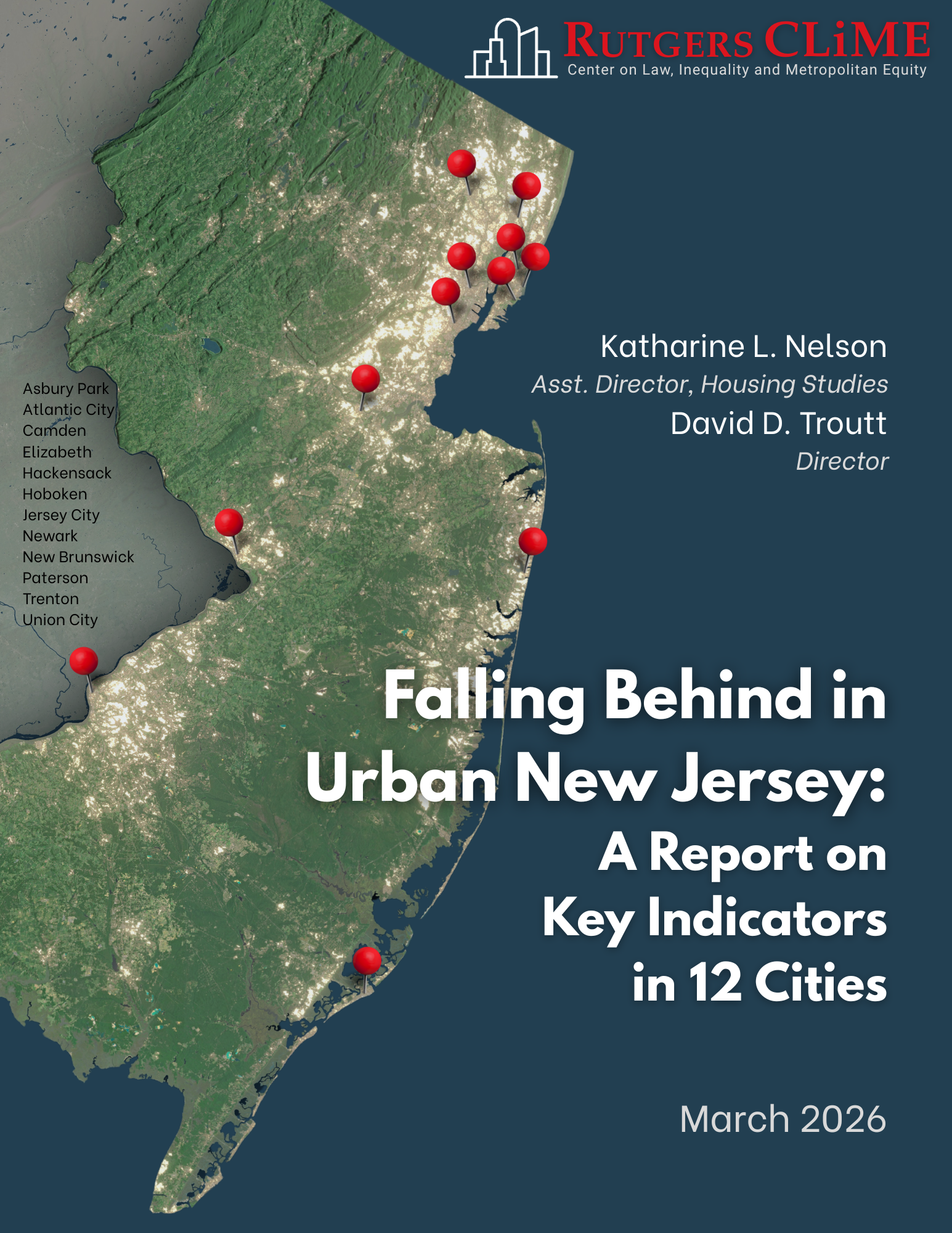
Falling Behind in Urban New Jersey: A Report on Key Indicators in 12 Cities

CLiME’s inaugural evaluation of 12 of New Jersey’s most populous cities reveals striking trends that reverse many of the last century’s assumptions about life in the Garden State. Despite dynamic changes in urban-suburban demographics, housing and job growth, one overriding fact prevails: economic inequality has hardened between cities and suburbs and within and across cities. We looked at social and economic trends in the state’s 12 most populous cities – Newark, Jersey City, Paterson, Hoboken, Union City, Hackensack, Asbury Park, New Brunswick, Trenton, Camden and Atlantic City – and found:

  • Urban population growth and residential development now outpaces the rest of the state.

  • The 12 cities are home to many working-class and immigrant residents, and more than half households struggle to make ends meet.

  • The 12 cities are home to the state’s poorest children, with poverty rates as high as 48 percent.

  • A lack of affordable housing is a problem statewide, but it’s especially pronounced in the gentrifying cities of the NY metro.

Read more to learn how these factors play out differently in different parts of the state and our recommendations for enhancing the economic prospects of New Jersey residents.

Read More
Why is the "Rent So Damned High"?

Why is The “Rent So Damned High”? explores the drivers of high and rising rents and proposes a series of policies to address rental unaffordability in New Jersey and respond to changes at the federal level. Most experts say the chief explanation for high rents is an undersupply of housing and push a “build, build, build” strategy to bring rents down. Our findings challenge the consensus. Through a deep dive of academic and public research, we identified four primary drivers of high and rising rents: inflation, undersupply, widening inequality, and the consolidation and professionalization of landlords and real estate.

Federal policy is embracing building as the foremost solution to the affordability crisis. Trump’s Big Bill permanently expanded the country’s largest affordable housing production subsidy program, the Low-Income Housing Tax Credit (LIHTC). Meanwhile, deeper subsidy programs that can reach low-income renters are threatened with large cuts. To make housing affordable, we must also address stagnant incomes and the consolidation of homebuilders and landlords.

Read More
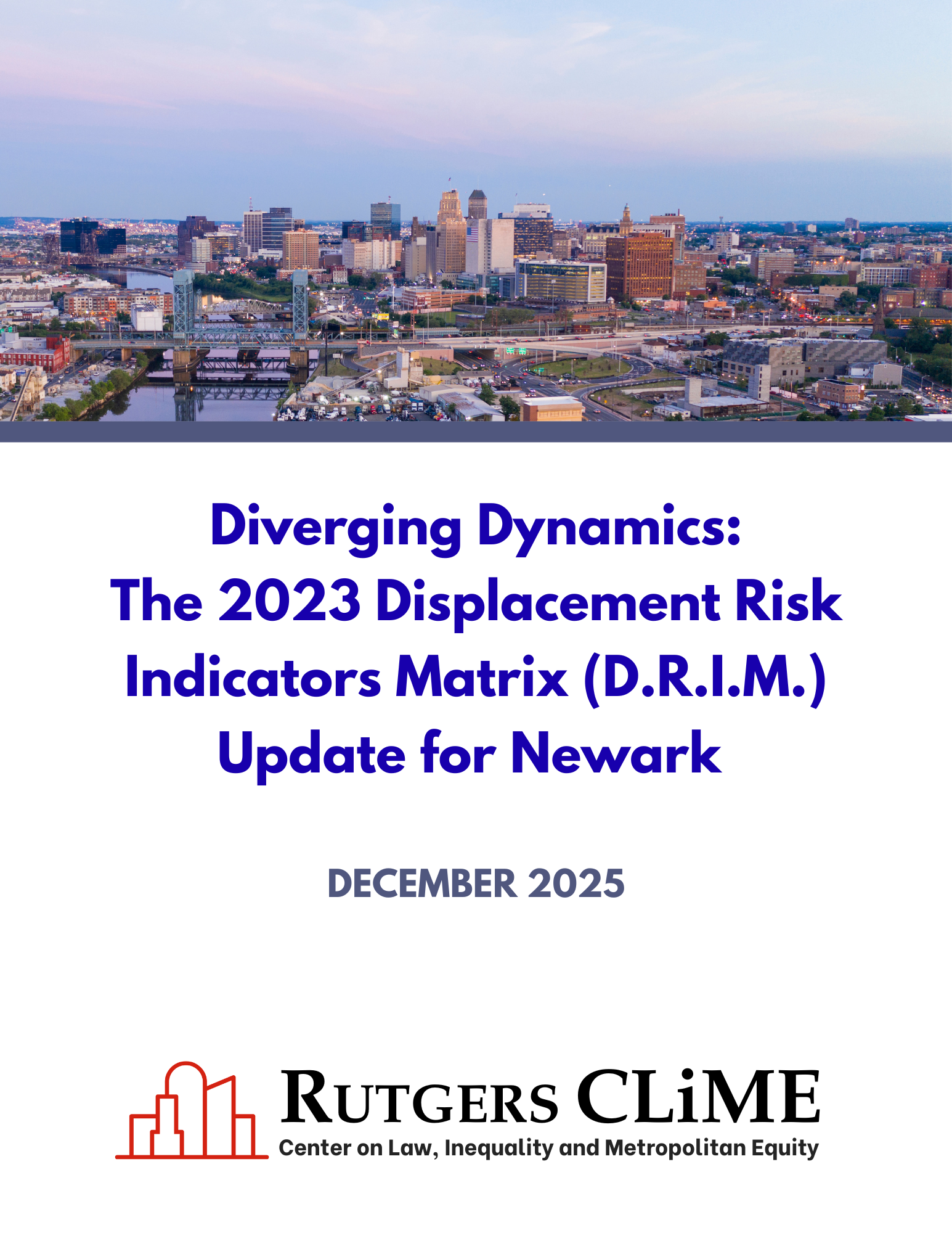
Diverging Dynamics: The 2023 Displacement Risk Indicators Matrix (D.R.I.M.) Update for Newark

Diverging Dynamics: The 2023 Displacement Risk Indicators Matrix (D.R.I.M.) Update for Newark explores how the risk of displacement in Newark has changed since 2010. Newark is experiencing the steady erosion of affordability as rents rise faster than incomes. In this latest installment of CLiME’s displacement analysis, diverging patterns of urban change are becoming clearer across wards with uneven but unmistakable signs of gentrification.

The East and Central Wards saw the most dramatic increases in new construction activity, the most rapidly rising rents, and the most pronounced increases in residents who are college-educated and/or affluent renters. The West Ward also shows signs of elevated renter vulnerability, with large increases in medium household incomes alongside rising rent burdens. The North Ward has very different housing market dynamics, with large increases in homeownership and much less residential construction. The South Ward shows the greatest signs of tenant vulnerability but also has the most affordable rental stock, compared to other parts of the city.

Read More
The Great Household Deficit: Rising Costs of Homeownership in New Jersey

New Jersey homeowners are sinking in monthly bills. In this brief, we explore the sky-high and rapidly rising costs of being a homeowner in New Jersey. This includes both mortgage and non-mortgage housing costs. New Jersey has the property taxes, and among the most expensive housing prices in the country. In addition, New Jersey homeowners pay 20 percent more in utility costs than the national average, and are now facing soaring electricity bills related to supply challenges and the new demands of AI data centers. New Jersey’s homeowners’ insurance premiums are also going up much faster than other states, related to private companies’ responses to more extreme weather and construction and labor costs. As these various costs add up, more homeowners – especially those with lower incomes – are sinking into debt and many are deferring home repairs and maintenance.

Read More
Who Owns Newark? Transferring Wealth from Newark Homeowners to Corporate Buyers

This report shows that the national trend in investor buying of 1-4 unit homes in predominantly Black neighborhoods is most acute in Newark, New Jersey where almost half of all real estate sales were made by institutional buyers. The trend grew out of the foreclosure crisis that wiped out significant middle-class wealth in particular Newark neighborhoods. Those neighborhoods became the targets of investors seeking passive returns from rents. Those largely anonymous outside companies now set neighborhood housing markets on terms that primarily benefit their investors.

While CLiME detected no illegal activity, the threats to Newarkers and government policy goals are significant. They include rapidly rising rents, decreased homeownership, higher barriers to affordable housing production goals, renter displacement and less stable communities. Sadly, this reality continues a long pattern of economic threats to predominantly Black and increasingly Latino neighborhoods in a state whose communities are among the most segregated in the country. From racial exclusion to predatory lending, from foreclosure to the extraction of rents, Newark’s experience demonstrates what can happen when local economies ignore equity.

CLiME’s analysis documents a dramatic increase in institutional investor activity in Newark’s residential market starting around 2013. As of 2020, almost half of all Newark’s residential sales were to institutional buyers.

Read More
Homes Beyond Reach: An Assessment and Gap Analysis of Newark's Affordable Rental Stock

CLiME conducted an affordability and gap analysis of Newark's housing stock and found a severe gap in low-rent units. We estimate that the City needs an additional 16,234 units renting for about $750 per month to meet residents' existing needs.

CLiME’s approach to assessing affordability is rooted in the local context. We calculate a Newark Median Affordable Rent (NMAR) of $763 per month. This is $330 less than Newark’s median market rent, and more than $600 less than Fair Market Rent (FMR), created by the Department of Housing and Urban Development. We also develop a methodological innovation to integrate the City’s rental housing subsidies into the affordability analysis. This procedure, the first of its kind as far as we know, provides a much closer picture of affordability in a City where at least 28% of all units are subsidized.

Read More
DRIM Analysis of Newark's Central Ward

Based on the previous DRIM analysis and updated 2017 DRIM analysis, three Wards have been analyzed and found to be Displacement-Risk Neighborhoods: The Central Ward, the South Ward, & the East Ward.  

To better understand the trend of displacement that has occurred between years 2000, 2015, & 2017, we conduct a baseline study to analyze the specific displacement risk indicators for one Ward: The Central Ward.

Read More
DRIM Update Memo

With the increased use of public land for the sake of economic development, cities across the U.S. are facing an urban construction boom. Through the 1980s and 1990s, Newark’s construction boom focused on land-use policies, especially the tax abatement strategies for bringing about capital-intensive projects. Simultaneously, Newark’s shift to a more neo-liberal solution led to a decline in public housing and section 8 vouchers.

As Newark experiences unprecedented growth potential, Newarkers express more and more anxiety about the prospects of housing displacement brought on by the processes of gentrification that have transformed urban neighborhoods across the United States.

Read More
The Cost of New York City’s Hudson Yards Redevelopment Project

ABSTRACT: Tax increment financing (TIF) has exploded in popularity on the municipal finance landscape as cities compete for scarce public resources to fund economic development. Previous studies evaluate TIF’s efficacy and ability to spark economic growth.

This research expands the evaluation of TIF by questioning the widespread understanding of TIF as a “self-financing” tool through an analysis of its risks and costs to taxpayers. We present a case study of the Hudson Yards redevelopment project in New York City, the country’s largest TIF-type project.

Read More
Making Newark Work for Newarkers: Housing and Equitable Growth in the Next Brick City

Making Newark Work for Newarkers is the full report of the Rutgers University-Newark Project on Equitable Growth in the City of Newark, written by CLiME and incorporating research conducted in conjunction with a university working group whose work began last April. We viewed the goal of equitable growth first in the context of housing issues before expanding to think about the fabric of community life and economic opportunity in the city.

Read More
Displacement Risk and Gentrification: The CLiME Displacement Risk Indicators Matrix (DRIM) Methodology

As Newark experiences unprecedented growth potential, Newarkers express more and more anxiety about the prospects of housing displacement brought on by the processes of gentrification that have transformed urban neighborhoods across the United States. Given the recent history of other cities in its metropolitan neighborhood—New York, Hoboken and Jersey City—Newark would seem poised to attract the kind of global capital that has accelerated so much economic development among …

Read More
Recommendations to the City of Newark, Mayor Ras Baraka

The Rutgers University-Newark Project on Equitable Growth was formed as a team of university researchers led by CLiME to provide research and recommendations about spreading the benefits of potential economic growth to all wards and neighborhoods in the City of Newark. Although housing and housing-related issues dominated our work, we viewed the task more broadly and asked: How does a working-class city in the midst of economic interest from a fast- growing metropolitan region harness …

Read More
Conference Brief - Psychological Trauma and Schools: How Systems Respond to the Traumas of Young Lives

On May 5, 2017, the Rutgers Center on Law, Inequality and Metropolitan Equity (CLiME) hosted an interdisciplinary all-day conference on the institutional responsibility of schools in responding to childhood psychological trauma, particularly in low-SES communities where early life trauma exposure is disturbingly ubiquitous. The conference brought together a group of panelists and audience members from diverse fields related to childhood trauma.

Read More
Criminal Customers: The Criminalization of Poverty and the Systemic Exploitation of the Working Class

Going to court is a stressful and frequently expensive ordeal. Most court appearances result in a monetary retribution, whether to an adversary or the state, and usually come with fine print. Financial obligation to another always comes with strings attached. For those unable to immediately meet their fiduciary duty, penalties can be severe. Inability to pay a fee often results in the tacking on of another fee, for being unable to pay the initial fine. With all these fines being imposed, one may feel as though being poor is a disadvantage in the justice system. The possibility of going to …

Read More
Disparities in Access to Prenatal Care: Perpetuation of Poverty and Inequality through the Healthcare System

This analysis addresses the disparity in prenatal health outcomes between the City of Paterson and Wayne Township in New Jersey. It guides the reader through the experiences of a hypothetical pregnant woman living in Paterson to examine the institutional and non-institutional factors that prevent this pregnant woman, and others like her, from accessing appropriate prenatal care. This paper also discusses the relationship between the inability to access proper prenatal care and the perpetuation …

Read More
Trapped in Tragedies: Childhood Trauma, Spatial Inequality and Law

Each year, psychological trauma arising from community and domestic violence, abuse and neglect brings profound psychological, physiological and academic harm to millions of American children, disproportionately poor children of color. This Article represents the first comprehensive legal analysis of the causes of and remedies for a crisis that can have lifelong and epigenetic consequences. Using civil rights and local government law, it argues that children’s reactions to complex trauma represent the natural symptomatology of severe structural inequality—legally …

Read More
Issue Brief: Child Poverty In Essex County 2000–2015

County, New Jersey between 2000 and 2015. The number of children living in poverty in Essex County has increased over the past 15 years, and in some places, quite dramatically. Increasing numbers of Essex County’s poor children live in neighborhoods of extreme poverty. There are also preliminary signs that child poverty has spread into formerly no- or low-poverty neighborhoods.

Read More
A Critical Review of the Psychological Literature

This report provides a critical and comprehensive review of the empirical literature on the sequelae of childhood exposure to potentially traumatic events (PTEs), with special emphasis on low socioeconomic status (SES) populations at disparate risk for exposure to PTEs across the lifespan. First, I will outline the categories and characteristics of childhood PTEs. Second, I will synthesize research on the proximal and distal consequences of childhood PTE exposure. Third, I will identify significant mediators (i.e., how or why PTE-related outcomes occur) …

Read More
ReportGuest UserPoverty, Trauma