
Publications
Publications on the CLiME site are designed as a digital portal into an educational research resource for issues of structural inequality, urbanism and metropolitan equity. Content is divided between types—articles, reports, presentations and public documents—and by subject. Externally created documents are briefly described, then linked to their sources; original CLiME scholarship is intermixed by subject or can be found under the CLiME tab.
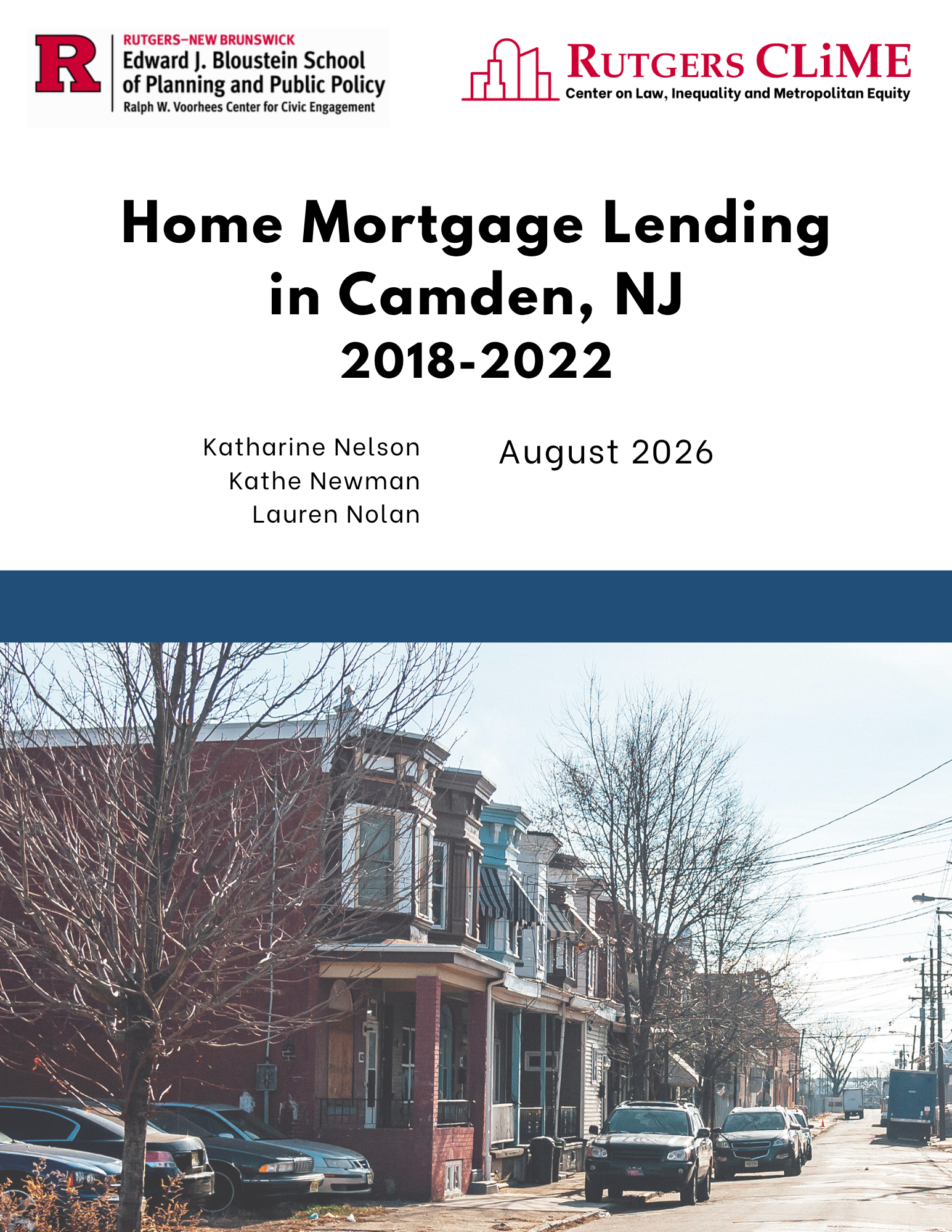
Home Mortgage Lending in Camden, New Jersey: 2018-2022
In partnership with the Rutgers Bloustein School's Voorhees Center for Civic Engagement and St. Joseph's Carpenter Society, a community development corporation in Camden, New Jersey, we sought to better understand home purchase and improvement lending in Camden between 2018 and 2022, a decade after the 2008 financial and liquidity crisis and the 2009 Great Recession significantly restricted credit access. We looked at patterns of home purchase and improvement mortgage originations, applications, and denials in Camden and found higher mortgage denial rates than elsewhere in the region, more expensive mortgages from the companies that have lower denial rates, and a critical gap in access to home repair loans. Our findings point to the prominent importance of non-depository mortgage companies in the provision of housing credit, raising concerns both about lender regulation and the need for greater bank presence in Camden's mortgage markets.

Guidance for Lawmakers on Investors & New Jersey Homes
CLiME’s Guidance for Lawmakers on Investors and New Jersey Homes responds to the flood of proposed legislation in New Jersey to respond to the growth of institutional investors in single-family homes. This report describes the pending bills in New Jersey and offers expert recommendations on how legislators should understand the combined policy effects of a range of efforts, including bans, opportunity to purchase restrictions, tax strategies, and responses to various harms to renters through tenant-protection laws.
We offer four top level recommendations for New Jersey lawmakers:
Create an executive agency tasked with developing the infrastructure necessary to regulate institutional investors in single-family homes in New Jersey.
Prioritize a first-look law that mandates a wait period before investors may bid on a home once it goes on the market.
Impose limits on property-related tax deductions such as mortgage interest and depreciation to disincentivize investor ownership of single-family homes.
Prioritize various tenant protection bills aimed at responding to specific harms renters face from growing dominance of corporate landlords, including rapid rent increases, increased eviction actions, and habitability concerns.

Legislative Briefing: Affordable Housing Reform: New Jersey A4
New Jersey's Assembly Bill A4 represents a landmark effort to comply with the Mount Laurel Doctrine and the state's growing affordable housing crisis by reforming how municipalities meet their fair share housing obligations. At the heart of this legislation is a standardized formula that requires each municipality to calculate its present and prospective affordable housing needs, along with other factors like population growth, land, and income capacity. By decentralizing housing planning, A4 shifts responsibility to local governments from the state and gives them a ten-year window to meet their fair share housing obligations.

Legislative Briefing: Wealth Preservation Act New Jersey No. 5664
On January 12, 2024, Governor Phil Murphy signed the Wealth Preservation Program law, an ambitious reorganization of the foreclosure process in favor of second chances, non-profit rights of second refusal and affordable home ownership. Then-Assemblywoman, now-Senator Britnee Timberlake, introduced this law because New Jersey has the highest foreclosure rate in the country, with one foreclosure for every 2,271 homes.[1] The potential impact of this law goes beyond just reducing the number of foreclosures. It potentially limits institutional investors’ opportunities to purchase foreclosed homes at sheriff’s sales by providing ordinary homebuyers initial opportunities to bid on properties on more favorable terms. Under the Act, defaulting homeowners, their next of kin or tenants have the first chance to re-purchase their homes from sheriff sales at a publicly disclosed discount price by paying only a 3.5% down payment with 90 days to close. If they do not elect to purchase, non-profit community development corporations (CDCs) have the next right of refusal in exchange for deed restrictions that keep the property affordable to subsequent owners or renters.

Legislative Briefing: New Jersey’s Revision to Tax Sale Foreclosures: New Jersey A3772
On July 10, 2024, Governor Phil Murphy signed a tax sale revision law (A3772/S-2334), which modifies the process for investors engaged in tax sale foreclosures and provides steps for homeowners to protect their equity. Senator Brian Stack (D-33) introduced this law in January 2024 in part because of the case of a 94-year-old Black woman named Geraldine Tyler, who lost her home and equity in the tax sale foreclosure process. In 1999, Mrs. Tyler purchased a one-bedroom condominium in Minneapolis, Minnesota. She lived in the condominium until 2010 when problems in the neighborhood prompted her to rent an apartment in a safer area. She experienced financial difficulties, leading her to get $2,300 in tax arrears, which increased to $15,000 with penalties and interest. In 2015, Hennepin County, Minnesota, seized her condominium, sold it for $40,000, and pocketed $25,000 in surplus equity. On May 25, 2023, the United States Supreme Court unanimously held in Tyler v. Hennepin County that the municipality violated the Takings Clause of the U.S. Constitution when they stripped and retained Mrs. Tyler’s equity.